
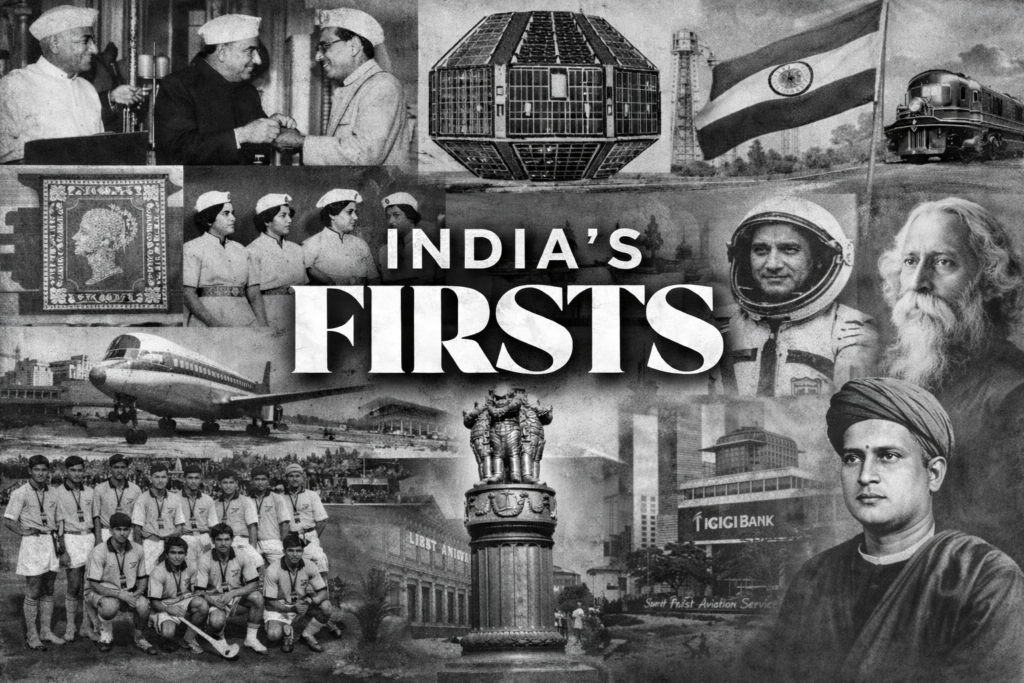
India’s journey as a nation is filled with powerful beginnings. Every institution we see today started with a first step taken by a real person at a defining moment in history. These firsts of India are not random facts. They are milestones that shaped democracy, defence, science, education, sports, governance, and social change. For children, knowing the firsts of India builds a strong general knowledge base. It helps them understand how the country was organised after independence and who carried the responsibility of leading it forward. The Junior Age has listed 50 firsts of India for you:
Political Leadership: The Firsts Of India
1. First President Of India: Dr Rajendra Prasad
Dr Rajendra Prasad became President in 1950 when the Constitution came into force. A freedom fighter and lawyer, he shaped the dignity and neutrality of India’s highest constitutional office. He remains the only President to serve two full terms.
2. First Vice-President Of India: Dr Sarvepalli Radhakrishnan
Dr Sarvepalli Radhakrishnan took office in 1952 and was globally respected as a philosopher and educationist. His birthday on 5 September is celebrated as Teachers’ Day in India. He later served as President of India.
3. First Prime Minister Of India: Jawaharlal Nehru
Jawaharlal Nehru became Prime Minister of India in 1947, following the country’s independence. He played a key role in building democratic institutions and promoting scientific thinking. His leadership shaped India’s early nation-building years.
4. First Deputy Prime Minister Of India: Sardar Vallabhbhai Patel
Sardar Vallabhbhai Patel served as India’s first Deputy Prime Minister from 1947 until his death in 1950. He led the integration of over 500 princely states into the Indian Union. His leadership earned him the title Iron Man of India.
5. First Speaker Of The Lok Sabha: G V Mavalankar
Ganesh Vasudev Mavalankar became Speaker in 1952 when India’s first Lok Sabha was formed. He established parliamentary rules, conventions, and discipline. His leadership set lasting democratic traditions, and he was popularly known as Dadasaheb.
6. First Woman Prime Minister Of India: Indira Gandhi
Indira Gandhi took office in 1966 and became India’s first woman Prime Minister. She led the country through major political, economic, and social changes. She was India’s second-longest-serving Prime Minister.
7. First Indian Governor-General Of Independent India: C Rajagopalachari
C Rajagopalachari assumed office in 1948 after Lord Mountbatten. He was the first Indian to hold the post of Governor-General. He served until India became a republic in 1950.
Constitutional And Legal Firsts Of India
8. First Chief Justice Of India: Justice H J Kania
Justice H J Kania became the first Chief Justice in 1950. He presided over the Supreme Court when it was formally established. His tenure laid the foundation for judicial independence.
9. First Law Minister Of India: Dr B. R. Ambedkar
Dr B. R. Ambedkar became India’s first Law Minister in August 1947. He also chaired the Drafting Committee of the Constitution. His work ensured equality, justice, and fundamental rights.
10. First Attorney General Of India: M C Setalvad
M C Setalvad (Motilal Chimanlal Setalvad) was appointed Attorney General in 1950. He served as the government’s chief legal adviser for over a decade. His opinions shaped early constitutional law.
11. First Chief Election Commissioner Of India: Sukumar Sen
Sukumar Sen conducted India’s first general elections in 1951–52. He managed voting for millions of citizens across vast regions. His work strengthened India’s democratic foundations.
12. First Woman Judge Of The Supreme Court Of India: Justice Fathima Beevi
Justice Fathima Beevi was appointed in 1989. She became the first woman to serve on the Supreme Court. Her appointment marked a historic milestone for women in law.
Defence And Military Firsts Of India
13. First Defence Minister Of India: Baldev Singh
Baldev Singh became India’s first Defence Minister in 1947. He oversaw the armed forces during the early post-independence years. His role helped stabilise defence administration.
14. First Indian Commander-In-Chief Of The Indian Army: General K M Cariappa
General K M Cariappa took charge in 1949 as the first Indian to lead the Army. He professionalised military leadership after British command ended. He was later promoted to Field Marshal.
15. First Chief Of The Indian Navy: Vice Admiral R D Katari
Vice Admiral R D Katari became Navy Chief in 1958. He was the first Indian to hold the post. His leadership strengthened India’s maritime defence.
16. First Chief Of The Indian Air Force: Air Marshal Subroto Mukerjee
Air Marshal Subroto Mukerjee became Chief of the Air Staff in 1954. He was the first Indian to lead the Indian Air Force. He played a key role in its modern development.
17. First Indian To Receive Param Vir Chakra: Major Somnath Sharma
Major Somnath Sharma received the Param Vir Chakra posthumously in 1950. He displayed exceptional bravery during the 1947–48 Kashmir conflict. He was India’s first recipient of the highest gallantry award.
18. First Field Marshal Of India: Sir Sam Hormusji Framji Jamshedji Manekshaw
Sir Sam Hormusji Framji Jamshedji Manekshaw was promoted to Field Marshal in 1973. He led the Indian Army during the 1971 war. His leadership contributed to the creation of Bangladesh.
Women Achievers And Social Leadership Firsts Of India
19. First Woman Governor Of India: Sarojini Naidu
Sarojini Naidu became the Governor of the United Provinces in 1947. She was a freedom fighter and poet. Her appointment symbolised women’s leadership in independent India.
20. First Woman Chief Minister Of India: Sucheta Kriplani
Sucheta Kriplani became Chief Minister of Uttar Pradesh in 1963. She was known for firm governance and discipline. She also played an active role in the freedom movement.
21. First Woman IPS Officer Of India: Kiran Bedi
Kiran Bedi joined the IPS in 1972. She became known for police reforms and prison administration. She later served in several national leadership roles.
22. First Woman IAS Officer Of India: Anna Rajam Malhotra
Anna Rajam Malhotra joined the IAS in 1951. She became the first woman officer of the service. Her career broke barriers in Indian administration.
23. First Woman Speaker Of The Lok Sabha: Meira Kumar
Meira Kumar became Speaker in 2009. She presided over parliamentary proceedings during a full Lok Sabha term. She also served as a senior diplomat.
Education, Science, And Knowledge Firsts Of India
24. First Education Minister Of India: Maulana Abul Kalam Azad
Maulana Azad became Education Minister in 1947. He laid the foundation for India’s modern education system. He promoted science, culture, and higher learning.
25. First Indian To Win A Nobel Prize: Rabindranath Tagore
Rabindranath Tagore won the Nobel Prize in Literature in 1913. He was honoured for Gitanjali. His achievement brought global recognition to Indian literature.
26. First Indian Scientist To Win A Nobel Prize: C V Raman
C V Raman won the Nobel Prize in Physics in 1930. He was awarded for discovering the Raman Effect. His work placed Indian science on the world stage.
27. First Indian Woman Nobel Laureate: Mother Teresa
Mother Teresa received the Nobel Peace Prize in 1979. An Indian citizen at the time, her work focused on compassion and service. She founded the Missionaries of Charity.
28. First Indian To Go To Space: Rakesh Sharma
Rakesh Sharma travelled to space in 1984 aboard a Soviet spacecraft. He spent 7 days and 21 hours in orbit. He became a symbol of India’s scientific progress.
29. First Indian Satellite: Aryabhata
Aryabhata was launched in 1975. It marked India’s entry into space research. The satellite was named after an ancient mathematician.
Sports, Culture, And Awards Firsts Of India
30. First Indian Olympic Medallist: Norman Pritchard
Norman Pritchard won two silver medals at the 1900 Paris Olympics. He competed representing British India. He is widely recognised as India’s first Olympic medallist.
31. First Indian Olympic Gold Medal: Indian Men’s Hockey Team
India won its first Olympic gold in hockey at the 1928 Amsterdam Games. This began India’s dominance in the sport. The team became a symbol of national pride.
32. First Indian Woman Olympic Medallist: Karnam Malleswari
Karnam Malleswari won a bronze medal in weightlifting at the 2000 Sydney Olympics. She became a trailblazer for women in Indian sports. Her success inspired future athletes.
33. First Indian To Win The Booker Prize: Arundhati Roy
Arundhati Roy won the Booker Prize in 1997. She was honoured for The God of Small Things. The win brought Indian fiction global attention.
34. First Indian Recipient Of Bharat Ratna: C Rajagopalachari
C Rajagopalachari received the Bharat Ratna in 1954. He was among the first recipients of India’s highest civilian award. The honour recognised his public service.
35. First Sportsperson To Receive Bharat Ratna: Sachin Tendulkar
Sachin Tendulkar received the award in 2014. He became the first sportsperson to be honoured. His career transformed Indian cricket.
Governance, Science, Environment, And Nation-Building Firsts Of India
36. First Finance Minister Of India: R K Shanmukham Chetty
R K Shanmukham Chetty presented India’s first Union Budget in 1947. He organised early financial planning. His work stabilised the new economy.
37. First Railway Train In India
India’s first railway train ran from Bombay to Thane in 1853. It marked the beginning of rail transport in the subcontinent. Railways later became India’s lifeline.
38. First Metro Rail Service In India: Kolkata
Kolkata Metro began operations in 1984. It was India’s first rapid transit system. It transformed urban transport.
39. First Planned City Of Independent India: Chandigarh
Chandigarh was planned after independence as a modern city. It was designed by architect Le Corbusier. It serves as the capital of Punjab and Haryana.
40. First Indian Satellite Launch Vehicle: SLV-3
SLV-3 was successfully launched in 1980. It placed the Rohini satellite into orbit. This proved India’s independent launch capability.
41. First Nuclear Reactor Of India: Apsara
Apsara became operational in 1956 at Trombay. It was India’s first research reactor. It marked India’s entry into nuclear science.
42. First IIT Established In India: IIT Kharagpur
IIT Kharagpur was established in 1951. It was the first Indian Institute of Technology. It laid the foundation for technical education excellence.
43. First Newspaper Of India: Hickey’s Bengal Gazette
Hickey’s Bengal Gazette was published in 1780. It was started by James Augustus Hickey. It marked the beginning of journalism in India.
44. First Indian Language Newspaper: Samachar Darpan
Samachar Darpan was launched in 1818 in Bengali. It was published from Serampore. It brought news to Indian readers in their own language.
45. First Radio Broadcast In India
India’s first organised radio broadcast took place in 1927 in Bombay. It was started by the Bombay Radio Club. This later evolved into All India Radio.
46. First Television Service In India
Television services began in Delhi in 1959. It started as an educational initiative. Television later expanded nationwide.
47. First National Park Of India: Jim Corbett National Park
The park was established in 1936 as Hailey National Park. It was later renamed Jim Corbett National Park. It became a model for wildlife conservation.
48. First Wildlife Sanctuary Of India: Vedanthangal Bird Sanctuary
Vedanthangal Bird Sanctuary was formally notified in 1936 in Tamil Nadu. It is among the oldest bird sanctuaries in India. It reflects early conservation efforts.
49. First Indian State Formed On Linguistic Basis: Andhra Pradesh
Andhra Pradesh was formed in 1953. It united Telugu-speaking regions. This decision reshaped India’s state reorganisation policy.
50. First State To Implement the Panchayati Raj System: Rajasthan
Rajasthan implemented the Panchayati Raj system on 2 October 1959 at Nagaur. It strengthened grassroots self-governance. The model was later adopted nationwide.
Subscribe to The Junior Age Newspaper – click here. Know more fun facts on The Junior Age’s YouTube!