
The YUVIKA 2026 programme by ISRO is once again opening doors for school students who dream of space, rockets and scientific discovery. Indian Space Research Organisation is organising a special programme for School Children called “Young Scientist Programme“, “YUva VIgyani KAryakram”, YUVIKA, to impart basic knowledge on Space Technology and Space Applications to the younger students, in emerging trends in space science and technology amongst the youngsters, who are the future building blocks of our nation. The Indian Space Research Organisation is inviting curious Class 9 students from across India to experience real space science learning. Designed to spark early interest in STEM careers, this national-level initiative allows students to step inside India’s premier space agency and learn directly from scientists and engineers.
Know All About YUVIKA 2026 – ISRO’s Space Programme for Class 9 Students:
The YUVIKA 2026 programme by ISRO stands for Young Scientist Programme and is a special outreach initiative by the Indian Space Research Organisation to nurture interest in space science among school students. Through this programme, selected students receive direct exposure to India’s space research ecosystem, including laboratories, research facilities and interactions with leading scientists.
YUVIKA 2026 programme includes:
- Interactive sessions on rockets, satellites and space science fundamentals
- Talks and guidance from ISRO scientists and space engineers
- Visits to ISRO laboratories and space research facilities
- Practical demonstrations of launch vehicles and satellite technology
- Learning how space technology helps in weather, communication and navigation
- Group activities, quizzes and teamwork-based scientific tasks
- Exposure to India’s major space missions and future projects
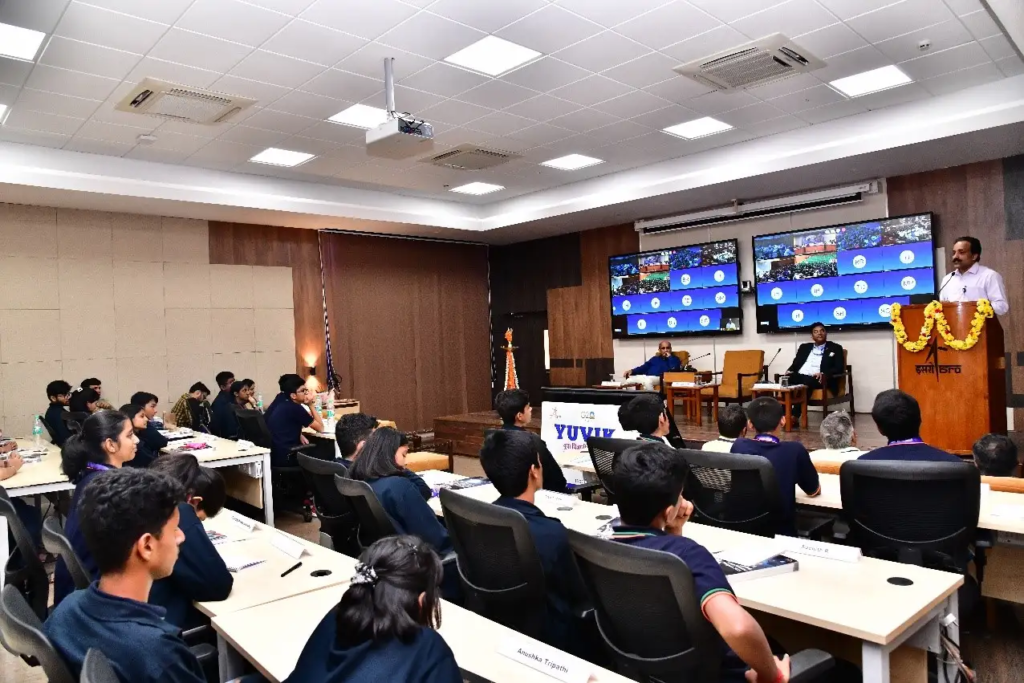
- Hands-on, two-week residential learning experience at ISRO centres across India
Key details
Eligibility: Students studying in Class 9 as of 1 January 2026
Registration dates: 27 February 2026 to 31 March 2026
Location: ISRO centres across India
Programme dates: 11 May to 22 May 2026
Duration: Two-week residential training programme
Application mode: Online application through the official ISRO website
Selection criteria of YUVIKA-2026 will be carried out based on the following parameters:
| Marks obtained in Class 8 or last conducted exam. | 50 % |
| Performance in the online quiz | 10% |
| Participation in science fair/co-curricular activities (school / district / state & above level in last 3 years) | 2/5/10% |
| Prize in Olympiad or equivalent (1 to 3 rank in School / District / State & above level in last 3 years) | 2/4/5% |
| Winners of sport competitions ( 1 to 3 rank in School / District / State & above level in last 3 years) | 2/4/5% |
| Scout and Guides / NCC / NSS Member in last 3 years | 5% |
| Studying in Village / Rural School located in Panchayat area | 15% |
Also, check out other details here.
Where will the programme take place?
Selected students will get the incredible opportunity to visit one of ISRO’s prestigious centres for the programme. The seven locations include:
- Indian Institute of Remote Sensing (IIRS), Dehradun
- Vikram Sarabhai Space Centre (VSSC), Thiruvananthapuram
- Satish Dhawan Space Centre (SDSC), Sriharikota
- UR Rao Satellite Centre (URSC), Bengaluru
- Space Applications Centre (SAC), Ahmedabad
- National Remote Sensing Centre (NRSC), Hyderabad
- North-Eastern Space Applications Centre (NE-SAC), Shillong
What about travel and expenses?
ISRO will fully cover the cost of lodging, boarding, and study materials. Additionally, travel expenses will be reimbursed as follows:
- Second AC train fare or AC bus fare (Volvo) from the student’s nearest railway station/bus terminal to the ISRO centre and back.
- Students must submit original travel tickets to claim reimbursement.
Note: The residential nature of the programme allows participants to fully immerse themselves in learning. Students interact with peers from across the country, share ideas and collaborate on activities, creating a national learning environment.
Subscribe to The Junior Age Newspaper – click here. Know more fun facts on The Junior Age’s YouTube!