
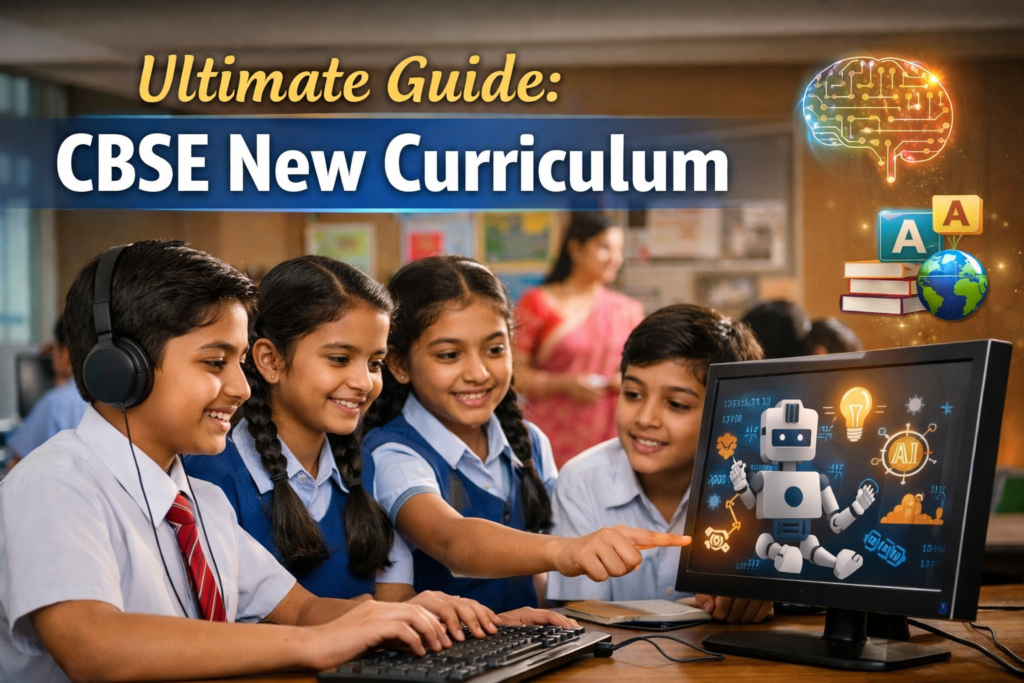
India’s education system is undergoing its most significant transformation in decades. The CBSE curriculum is being redesigned under the National Education Policy (NEP) 2020 and the National Curriculum Framework (NCF) 2023. The goal is a shift from rote memorisation to a “competency-based” model focusing on skills, creativity, and real-world application. This guide breaks down every major update, from the new language rules to board exam changes, in clear and simple language.
Here’s a guide to the CBSE school reform – three languages, skills and AI learning:
Timeline:
- 2024–25 (Active): New textbooks and learning methods introduced for Classes 3 and 6.
- 2025–26 (Current): New textbooks and frameworks expanded to Classes 4, 5, 7, and 8.
- 2026 Onwards: The first session of Biannual (Twice-a-year) Board Exams is expected for Class 10.
- 2026–27 (Upcoming): Mandatory 3-language rules for Class 6 and the “Two-Level” subject system for Class 9 officially begin.
New School Structure: The 5+3+3+4 Model
The old 10+2 system has been replaced by a structure that aligns with a child’s developmental stages.
| Stage | Classes | Age | Focus |
|---|---|---|---|
| Foundational | Preschool + Classes 1–2 | 3–8 | Play-based & discovery learning |
| Preparatory | Classes 3–5 | 8–11 | Building blocks of literacy and numeracy |
| Middle | Classes 6–8 | 11–14 | Abstract subject learning begins |
| Secondary | Classes 9–12 | 14–18 | Multidisciplinary study & flexibility |
CBSE New Three Language System: R1, R2, and R3
The “Three-Language Formula” is now categorized by proficiency levels to ensure students become multilingual.
What R1, R2 and R3 mean:
R1 – First language
Usually the home language, regional language or mother tongue.
R2 – Second language
Usually Hindi or English depending on the region.
R3 – Third language
Another Indian or foreign language chosen by the school or student.
Language learning across classes
Foundational stage – Classes: Preschool to Class 2
Teaching is encouraged in the mother tongue or regional language wherever possible. This helps children understand ideas faster and become confident readers.
Preparatory stage – Classes: 3 to 5
Students typically study two languages.
Example structure:
• R1 – Home or regional language
• R2 – English or Hindi
Middle stage – Classes: 6 to 8
Students begin learning three languages.
Example structure:
• R1 – Regional language
• R2 – English or Hindi
• R3 – Another Indian language or foreign language
Examples of R3 languages may include:
• Sanskrit
• French
• German
• Spanish
• another Indian language
Secondary stage – Classes: 9 to 10
Students must continue studying all three languages and pass them in board examinations where applicable. Language learning ensures students develop multilingual communication skills, which research shows improves cognitive development.
Two-Level Subject System (Starting 2026–27)
To reduce exam stress, CBSE is introducing “Two-Level” exams for core subjects like Mathematics and Science, starting with Class 9 in the 2026 session.
- Standard Level: The base requirement for all students.
- Advanced Level: An optional higher-difficulty paper for students who want to test higher-order thinking. Scores are recorded separately on the marksheet.
Artificial Intelligence and technology subjects
Technology education is another major focus of the new curriculum. CBSE introduced Artificial Intelligence as a skill subject in secondary classes.
Classes 9 to 12
Schools can offer Artificial Intelligence as a skill subject. Students learn:
• basics of Artificial Intelligence
• machine learning ideas
• data and algorithms
• ethical use of technology
• real-world AI applications
Technology exposure in earlier classes: Before Class 9, students learn digital literacy and computational thinking through computer science activities and digital learning tools. This helps students develop logical thinking and technology awareness.
Vocational education:
A key NEP reform introduces vocational education in middle school.
Starting class – Class 6
Students may learn practical skills such as:
• carpentry
• gardening
• electrical basics
• coding
• design thinking
• entrepreneurship
Skill subjects introduced by CBSE
CBSE offers several skill-based subjects in Classes 9–12. Examples include:
• Artificial Intelligence
• Information Technology
• Data Science
• Financial literacy
• Marketing
• Retail management
• Tourism
• Healthcare
Board Exam Reforms:
- Biannual Exams: Starting in 2026, board exams will be held twice a year. Students can sit for both and keep their best score.
- Competency-Based Questions: Over 50% of the paper now consists of case studies and application-oriented problems rather than direct textbook definitions.
The new CBSE curriculum represents a major shift in Indian schooling. Through multilingual education, AI learning, vocational skills, flexible subjects and competency-based assessments, schools are moving towards a more modern education system. The ultimate goal is to ensure students graduate with knowledge, skills and confidence to succeed in a rapidly changing world.
Subscribe to The Junior Age Newspaper – click here. Know more fun facts on The Junior Age’s YouTube!