
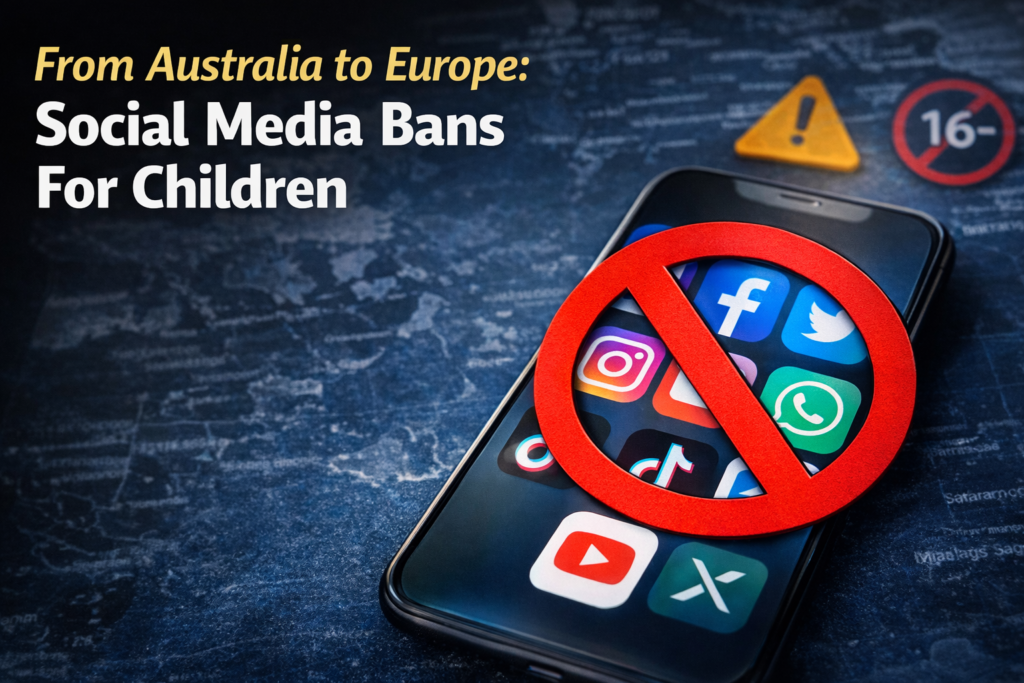
Across the world, governments are taking stronger steps to regulate how children use social media. Concerns about mental health, cyberbullying, screen addiction and online safety have pushed many countries to rethink whether young users should have unrestricted access to platforms such as TikTok, Instagram, Facebook and YouTube. Governments across Europe, Asia and the Americas are now introducing age limits, parental consent rules, platform restrictions and screen-time controls to protect minors online. Below is a detailed breakdown of what different countries are doing to regulate children’s access to social media and why these policies are being introduced.
Global Crackdown on Children’s Social Media Use: Why Countries from Australia to Europe are Introducing New Restrictions
Australia introduces the world’s toughest social media ban for children under 16
Australia became the first country in the world to introduce a nationwide ban on social media for children under 16. The law took effect on December 10, 2025, requiring major platforms to block minors from creating or maintaining accounts. Platforms affected include: TikTok, YouTube, Instagram, and Facebook. Companies that fail to enforce the rule face penalties of up to A$49.5 million. The government introduced the law after growing concerns that social media could negatively affect children’s health, mental wellbeing and safety.
Austria moves to ban social media access for children under 14
Austria has announced plans to introduce a social media ban for children up to the age of 14. The conservative-led government said draft legislation will be prepared and finalised by June, according to officials including Vice Chancellor Andreas Babler and digitisation minister Alexander Proell. The proposal aims to strengthen child protection in the digital environment by limiting early exposure to social media platforms.
Brazil introduces digital law linking children’s accounts to parents
Brazil has introduced a major regulation through the Digital Statute of Children and Adolescents. Under this law:
• minors under 16 must link social media accounts to a legal guardian
• platforms must remove addictive features such as infinite scrolling
The law came into force March 17, 2026 aiming to reduce digital addiction among young users. Brazil’s approach focuses more on platform design and parental supervision rather than an outright ban.
Britain considers an Australia-style ban and stricter online safety testing
The United Kingdom is studying whether to introduce an Australia-style ban on social media for children under 16. Technology minister Liz Kendall said the government is reviewing the possibility of new restrictions and stronger safeguards for AI chatbots used by children. To study the impact of restrictions, Britain is running experiments in 300 households, testing measures such as:
• social media bans
• app time limits
• digital curfews
Researchers will examine how these changes affect sleep, schoolwork and family life.
China introduces “minor mode” to control screen time and online content
China has introduced strict digital controls through a system known as “minor mode.” Under these rules:
• smartphones and apps must include age-based screen time limits
• certain apps have special restrictions for minors
• children’s access to digital platforms is automatically regulated
The system applies device-level restrictions combined with app-specific rules, giving parents and regulators greater control over how long children can stay online.
Denmark proposes banning social media for children under 15
Denmark announced plans to ban social media access for children younger than 15. However, parents may still allow access to certain platforms for children as young as 13, depending on the service and parental supervision. The proposal reflects growing concern about the impact of digital platforms on young people’s mental health and well-being.
France moves toward banning social media for children under 15
France’s National Assembly approved legislation aimed at banning social media access for children under 15. The bill still needs approval from the French Senate before becoming law. French lawmakers have cited increasing cases of online bullying and mental health issues among teenagers as key reasons behind the proposed restrictions.
Germany allows social media for teenagers only with parental consent
Germany currently allows teenagers aged 13 to 16 to use social media platforms only with parental consent. However, child protection advocates say the existing controls are not strong enough, as many children still manage to open accounts without parental approval. Debates continue about whether stricter regulation is needed.
Greece announces a nationwide ban on social media for under-15s starting 2027
Greece has announced that it will ban social media access for children under 15 beginning January 1, 2027. Prime Minister Kyriakos Mitsotakis confirmed the decision, citing growing concerns about digital addiction and online safety risks for children.
India begins regional restrictions while national debate grows
India has started seeing early policy moves at the state level.
The southern state of Karnataka became the first Indian state to ban social media use for children under 16. Other states, such as Goa and Andhra Pradesh are also considering similar restrictions. At the national level, India’s Chief Economic Adviser has argued that social media platforms behave in “predatory” ways by keeping users engaged for long periods.
Indonesia begins shutting down social media accounts owned by children under 16
Indonesia will restrict access to social media platforms for children under 16, its communications and digital ministry said on March 6. From March 28, accounts owned by children under 16 on “high risk platforms”, including TikTok, Facebook, Instagram and Roblox, will be gradually deactivated, Communications and Digital Minister Meutya Hafid said.
Italy requires parental consent for younger social media users
Italy has introduced a parental consent rule for younger users. Under the policy:
• children under 14 must obtain parental permission to create social media accounts
• teenagers above 14 can join platforms without consent
The rule is designed to give parents more control over children’s online activities.
Malaysia plans to ban social media access for children under 16
Malaysia has announced plans to ban social media use for children under 16 starting in 2026. The move reflects growing concern about screen addiction and online safety among teenagers.
Norway considers raising the digital age limit for social media access
Norway is working on legislation to raise the age at which children can legally agree to social media terms of service. The government has proposed:
• raising the age of consent from 13 to 15
• introducing an absolute minimum age of 15
Parents would still be allowed to give permission for children below the age limit.
Poland prepares legislation banning social media for children under 15
Poland’s ruling party has announced plans to introduce legislation banning social media access for children under 15. The proposed law would also require platforms to verify users’ ages, placing responsibility on companies to enforce the rules.
Portugal requires parental consent for teenagers using social media
Portugal has passed a law requiring explicit parental consent for children aged 13–16 to access social media. Technology companies that fail to comply may face fines of up to 2% of their global revenue.
Slovenia drafts legislation banning social media for children under 15
Slovenia is preparing legislation that would ban children under 15 from accessing social media platforms. The draft law was announced by Deputy Prime Minister Matej Arcon.
Spain proposes a nationwide ban on social media for users under 16
Spain has proposed banning social media access for children under 16. The plan would also require platforms to introduce age verification systems to ensure minors cannot bypass the restrictions.However, the proposal may still need approval from the country’s parliament before it becomes law.
United States regulates children’s data but faces legal challenges
In the United States, the Children’s Online Privacy Protection Act (COPPA) restricts companies from collecting personal data from children under 13 without parental consent. Some U.S. states have also introduced laws requiring parental permission for teenagers to use social media, though several of these laws have faced court challenges on free speech grounds.
European Union debates a common age limit for social media access
At the European level, lawmakers are discussing broader digital rules. The European Parliament has supported a proposal suggesting:
• a minimum age of 16 for social media use
• a harmonised digital age limit of 13 for video-sharing platforms and AI companions
The resolution is not legally binding, but it reflects growing political pressure for stricter regulation across Europe.
The debate about children and social media is rapidly spreading across the world. From Australia’s strict nationwide ban to new laws being drafted across Europe, Asia and the Americas, governments are increasingly stepping in to regulate how minors interact with digital platforms. While the policies vary from country to country, the underlying concern is the same: ensuring that children can grow up in a safer and healthier digital environment. As technology continues to shape everyday life, the challenge for governments will be finding the right balance between protecting young users and allowing them to benefit from the opportunities of the online world.
Learn: Talking To Teens About Social Media Bans
Subscribe to The Junior Age Newspaper – click here. Know more fun facts on The Junior Age’s YouTube!