
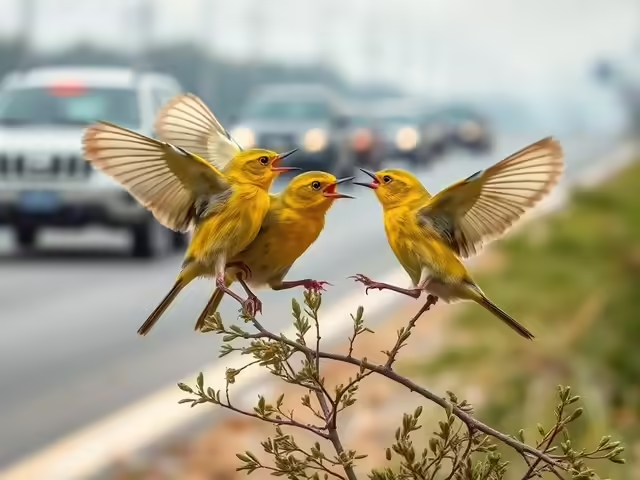
Birdsong is not just music in nature. It is how birds talk, warn rivals, and protect their space. However, what happens when those songs are drowned out by loud human noise? A new study shows that for some birds, the result is stress and anger. Galápagos yellow warblers are changing their behaviour in surprising ways, and traffic noise appears to be the reason.
Know Why The Galápagos Warble Are Angry:
A recent study found that Galápagos yellow warblers become much more aggressive when they live closer to roads. The louder the traffic noise from cars and trucks, the stronger the reaction from the birds. Normally, these warblers use their beautiful songs to defend their territory. However, traffic noise makes it hard for other birds to hear them. It is almost like someone shouting over their voices, and this makes the birds frustrated and upset.
The research was carried out by scientists from Anglia Ruskin University and the University of Siena. They studied yellow warblers at 38 different locations across the Galápagos Islands.
- 20 sites were within 50 metres of a road
- 18 sites were more than 100 metres away from roads
To understand bird behaviour, researchers played sounds that mimicked intruder birds and traffic noise near the warblers. They recorded the songs the birds sang and closely observed how they behaved.
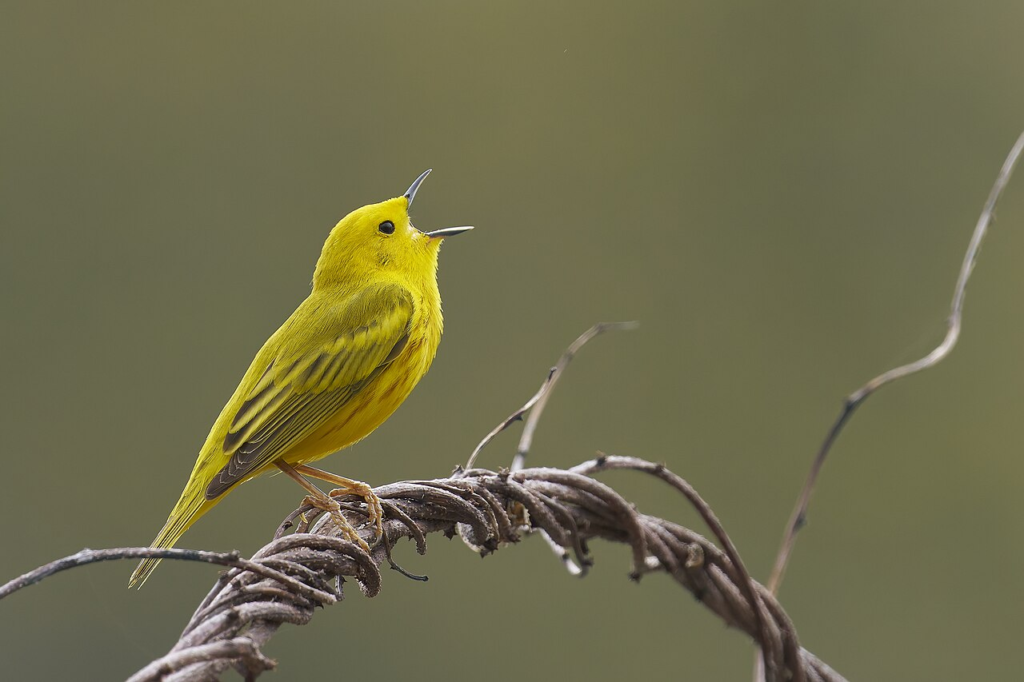
The results were clear. Warblers living near roads acted far more aggressively, often flying very close to the sound source and crossing over it again and again. In contrast, birds living farther away from roads showed much calmer behaviour.
Scientists also noticed that the warblers are changing their songs so they can be heard above traffic noise. This shows how wildlife tries to adapt, even when human activity disrupts natural behaviour. This study highlights how noise pollution affects animals, not just humans. Roads and traffic do not only change landscapes. They can change behaviour, communication, and stress levels in wildlife too.
Did you know? The Galapagos Islands are located about 600 miles off the coast of Ecuador in the Pacific Ocean. The Galapagos is home to many unique animals found nowhere else on Earth.