
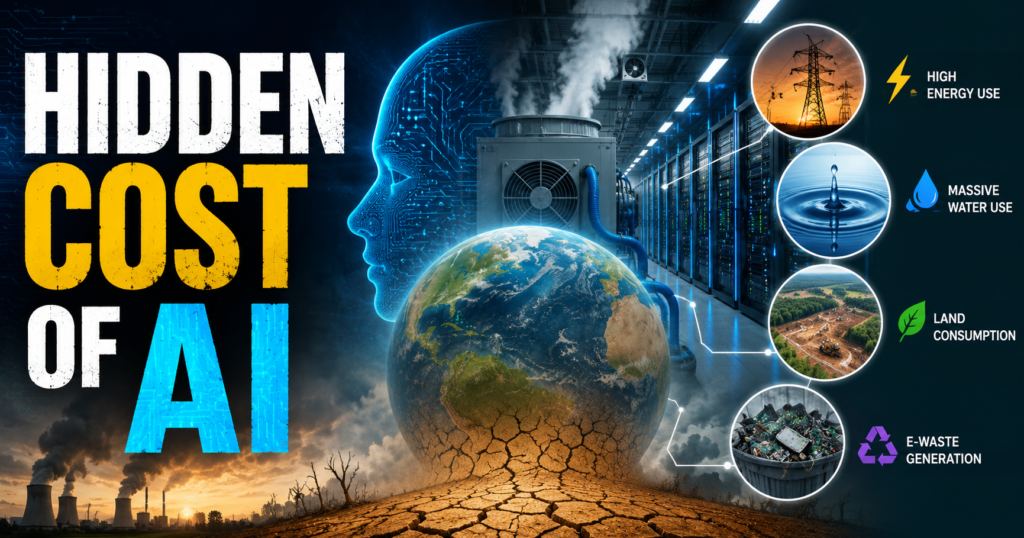
Artificial intelligence is transforming the way people learn, work, create, and solve problems. From chatbots and search engines to medical research and self-driving technology, AI is becoming part of everyday life. But while Artificial Intelligence offers many exciting benefits, scientists are warning that it also has a hidden environmental cost that many people do not see. A new report from the United Nations University Institute for Water, Environment and Health highlights how the rapid growth of Artificial Intelligence could place increasing pressure on the planet’s water, energy, land, and climate resources.
Why does AI use so much energy?
AI systems rely on massive facilities called data centres. These buildings contain thousands of powerful computers that process huge amounts of information every second. Training and running advanced Artificial Intelligence models requires enormous computing power. As more people use Artificial Intelligence tools, companies need larger and more powerful data centres to meet demand. According to the report, AI-related data centres could eventually consume as much electricity in a year as an entire country such as Japan uses today.
The surprising role of water
Many people do not realise that AI also requires large amounts of water. The powerful computers inside data centres generate a lot of heat. To prevent them from overheating, cooling systems use water to keep equipment at safe temperatures.
Researchers estimate that by 2030, AI data centres could use around 9.3 trillion litres of water every year for cooling. That is enough water to fill millions of Olympic-sized swimming pools.
How much electricity could AI use?
The report estimates that Artificial Intelligence data centres could consume:
- 945 terawatt-hours of electricity every year by 2030
- Vast amounts of energy to power servers and cooling systems
- Increasing amounts of electricity as Artificial Intelligence technology becomes more widespread
For comparison, a terawatt-hour is a huge amount of electricity capable of powering large cities for extended periods.
The problem of electronic waste
Another challenge is electronic waste, often called e-waste. Computers, servers, chips, and other electronic equipment eventually wear out and need replacing. When these devices are discarded, they can create large amounts of waste containing valuable materials as well as potentially harmful substances. The report warns that Artificial Intelligence-related infrastructure could generate up to 2.5 million tonnes of e-waste each year by 2030.
Artificial Intelligence also needs land
Data centres require large buildings, power connections, cooling facilities, and supporting infrastructure. As demand for Artificial Intelligence grows, more land may be needed to build and expand these facilities. This can increase pressure on local resources and communities if not managed carefully.
Can Artificial Intelligence become more sustainable?
Experts stress that AI itself is not the problem. In fact, Artificial Intelligence can help scientists tackle environmental challenges by improving weather forecasting, monitoring forests, reducing energy waste, and supporting climate research. However, the report says governments, technology companies, and users must work together to make Artificial Intelligence more sustainable. Possible solutions include:
- Using renewable energy such as solar and wind power
- Designing more energy-efficient computer chips
- Recycling electronic equipment
- Improving water-saving cooling systems
- Building greener data centres
Artificial Intelligence is expected to play an increasingly important role in the future. Understanding its environmental impact can help people make informed decisions about how technology is developed and used. The challenge for the future is finding a balance between the benefits of Artificial Intelligence and the resources needed to power it. With smart planning and innovation, experts believe Artificial Intelligence can continue to grow while reducing its impact on the planet.
This story connects with:
- SDG 7: Affordable and clean energy
- SDG 12: Responsible consumption and production
- SDG 13: Climate action
- SDG 15: Life on land
Read about all the 17 Sustainable Development Goals Explained: How The World Plans A Better Future By 2030
Subscribe to The Junior Age Newspaper – click here. Know more fun facts on The Junior Age’s YouTube!