
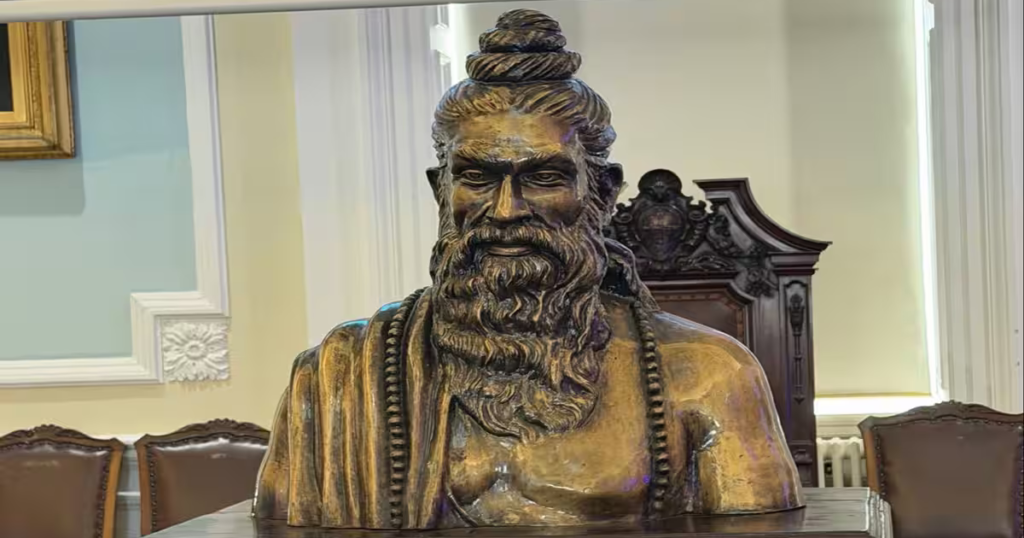
Many medical techniques used today have roots that go back thousands of years. Long before modern hospitals and advanced technology, ancient scholars were studying the human body, developing treatments, and performing surgical procedures. One of the most remarkable pioneers in medical history was Maharishi Sushruta, whose work continues to be recognised around the world. Now, his contributions have received international recognition with the unveiling of a bronze statue at one of the world’s leading surgical institutions.
Bronze statue of Maharishi Sushruta unveiled in Edinburgh
A bronze statue of Maharishi Sushruta, widely known as the Father of Surgery, has been unveiled at the Royal College of Surgeons of Edinburgh in Scotland. The statue weighs 90 kilograms and was created by master artisans from Swamimalai, a town in Tamil Nadu famous for its traditional bronze sculptures and centuries-old metal-casting techniques.
The installation honours Maharishi Sushruta’s extraordinary contributions to medicine and surgery and celebrates India’s rich scientific and medical heritage on the global stage.
Who was Maharishi Sushruta?
Maharishi Sushruta lived in ancient India more than 2,500 years ago and is regarded as one of the world’s earliest surgeons. He authored the Sushruta Samhita, an important medical text that described hundreds of diseases, treatments, surgical instruments, and medical procedures. The book is considered one of the earliest and most influential works on surgery in human history. His writings demonstrated a deep understanding of anatomy and surgical techniques at a time when modern medicine had not yet developed. The Sushruta Samhita is regarded as one of the world’s oldest medical texts. It includes detailed information about:
- Surgical procedures
- Medical instruments
- Treatment methods
- Human anatomy
- Patient care and recovery
Historians and medical experts believe the text helped lay the foundations for many surgical practices that developed over the centuries.
The statue in Edinburgh recognises the global impact of Maharishi Sushruta’s work and highlights the important role ancient India played in the development of medical science. It also serves as a reminder that knowledge and innovation have emerged from many cultures throughout history, helping shape the modern world. For India, the honour celebrates a remarkable figure whose contributions continue to inspire doctors, surgeons, researchers, and students around the globe.
Did you know? Maharishi Sushruta described more than 300 surgical procedures and over 100 surgical instruments in the Sushruta Samhita, making it one of the most advanced medical texts of the ancient world.
Subscribe to The Junior Age Newspaper – click here. Know more fun facts on The Junior Age’s YouTube!