
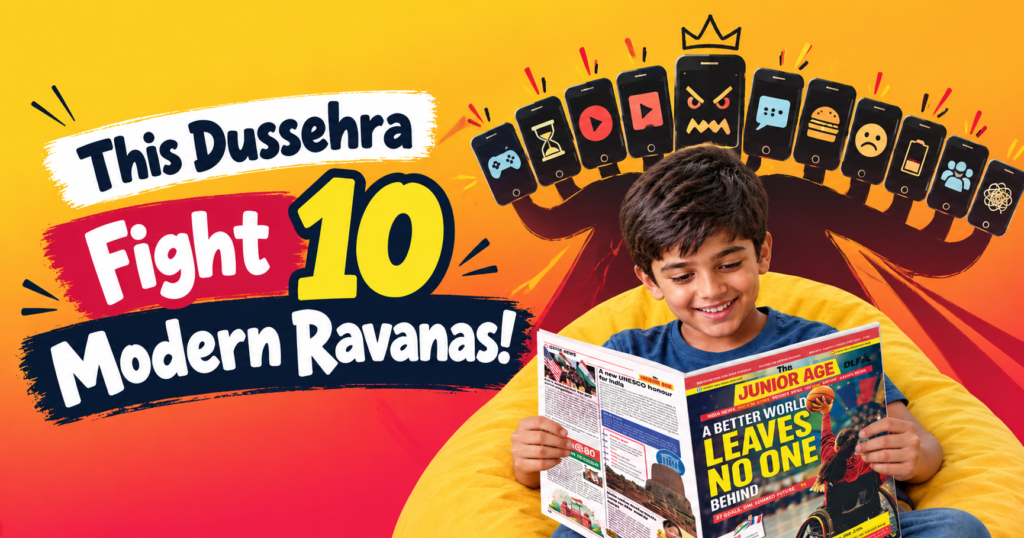
Dussehra celebrates victory over evil. But what if some of the things children need to defeat today do not look like Ravana at all?
Ravana may belong to an ancient epic, but the idea of defeating what holds us back can still feel surprisingly modern. Today, a child’s Ravana might be a phone that keeps calling for one more video. It could be homework that keeps getting pushed to tomorrow. Or perhaps it is the little voice saying, I am not good enough.
This Dussehra, let’s look beyond the giant effigy and spot 10 modern Ravanas that can sneak into a child’s everyday routine. And no, this is not about being perfect. Everyone faces these challenges sometimes. The real victory is learning how to handle them.
1. The Endless-Scrolling Ravana
Just one more video.
Sound familiar?
A quick scroll can turn into another video, then another, and suddenly half an hour has disappeared. Screens are useful for learning and entertainment, but endless scrolling can eat into time meant for sleep, homework, reading, exercise and family. The trick is not to declare war on every screen.
Instead, create screen-free pockets in the day. Keep phones away during meals, homework, and bedtime, and make space for offline activities.
The Dussehra lesson: You control the screen. The screen should not control your time.

Read about: Economic Survey 2025-26 Proposes Social Media Age Limit for Children
2. The Procrastination Ravana
I’ll do it later.
Three words that can turn a tiny task into a giant one. Whether it is homework, packing a school bag or finishing a project, putting things off can make them feel much harder later.
Try the five-minute trick. Start the task for just five minutes. Once you begin, continuing often feels easier. You can also divide a big assignment into smaller jobs.
Instead of: Finish my science project. Try:
- Choose the topic.
- Find three facts.
- Make the rough design.
- Write the first section.
- Check the final work.
One small victory at a time.
3. The Distraction Ravana
A notification pops up.
A toy catches your eye.
Someone starts talking.
And suddenly, the maths problem you were solving has completely disappeared from your brain. Distractions are everywhere, especially when children are trying to concentrate.
However, a simple solution is to create a distraction-free zone for important tasks. Put the phone away, clear the desk and keep only what is needed for the activity. Then give the task your full attention for a short period before taking a break.
The Dussehra lesson: Sometimes defeating a distraction simply means giving your attention to one thing at a time.
4. The ‘Comparison’ Ravana
Why did they get better marks?
Why does everyone else seem more talented?
If my friend likes it, why don’t I look like that?
Children can compare themselves with classmates, friends, siblings and people they see online. But comparison can hide something important: everyone has a different starting point, pace and set of strengths.
Instead of asking, Am I better than them?, try asking: What can I do better than I could yesterday?
That could mean reading one more page, improving a cricket shot, solving a tougher problem or simply having the courage to try something new.
The Dussehra lesson: Your biggest competition can be yesterday’s version of you.
5. The Junk Food Ravana
Crisps, sweets, sugary drinks and fast food can be delicious. But when these foods start taking the place of nutritious meals too often, the balance can tip the wrong way.
Children need a varied diet that includes foods such as fruit, vegetables, whole grains and protein-rich foods.
So instead of thinking healthy food versus fun food, think balance.
A sweet treat can be enjoyed. But it should not push all the other good stuff off the plate.
The Dussehra lesson: Good choices do not have to be boring.

6. The Late Night Ravana
One more episode. One more game. One more chapter.
And suddenly it is way past bedtime!
Sleep is not wasted time. Children need enough sleep to support their growing bodies, learning and everyday energy. A regular bedtime routine can help. Try switching off screens before bed and keeping bedtime and wake-up times reasonably consistent.
And yes, sometimes a special occasion means staying up later. That is different from turning late nights into an everyday habit.
The Dussehra lesson: Rest is part of being ready for the next day.
7. The Clutter Ravana
Ever searched for a pencil while sitting at a desk covered with books, toys, wrappers and random bits of paper?
Clutter can turn simple jobs into frustrating treasure hunts. The solution is surprisingly simple: give things a home.

Books go on the shelf. Stationery goes in its place. Toys go back in their box. Old papers get sorted. Try a five-minute tidy-up before bed. It is not about having a picture-perfect room. It is about making your space easier to use.
The Dussehra lesson: Sometimes clearing the mess outside helps clear the chaos around you too.
8. The ‘Negative Self-Talk’ Ravana
I can’t do this.
I’m terrible at maths.
I’ll never get it right.
Everyone makes mistakes. The problem starts when one mistake becomes a reason to believe you cannot improve. Try adding one tiny word: yet.
I can’t do this yet. I don’t understand this yet. I haven’t learnt this yet.
That small change turns a final statement into an invitation to keep trying.
The Dussehra lesson: A mistake can be a stop sign, or it can be a stepping stone.
9. The Always-Busy Ravana
School. Homework. Tuition. Sports. Music. Competitions. Projects. Repeat.
Being busy all the time does not automatically mean being productive or happy. Children also need time to play, rest, imagine, read for fun and simply be themselves.
Unplanned time matters too. That is when a child might build a cardboard spaceship, invent a game, draw a silly picture or suddenly become fascinated by an ant walking across the garden.
The Dussehra lesson: Not every minute needs to be filled.

10. The ‘I Will Never Try’ Ravana
When you see a difficult maths question and give up. A new sport looks intimidating, so you never try. A book seems too difficult, so it goes back on the shelf.
Sometimes the fear of getting something wrong becomes bigger than the challenge itself. The answer?
Try before deciding you cannot.
Try once. Then try again.
Ask for help. Practise.
Still not working? Then change your approach.
And remember that being a beginner is completely normal.
The Dussehra lesson: Courage does not always mean winning. Sometimes it simply means having another go.
This Dussehra, gift curiosity!
This Dussehra, don’t just burn an effigy. Help your child identify the everyday habits they want to defeat, one small victory at a time. And when you are ready to replace a little screen time with something more curious, colourful and meaningful, explore The Junior Age Festive Bundles:
1. Grand Festive Bundle: 1-year print subscription + four flash card packs for ₹3,100, down from ₹3,996.
It includes 24 fortnightly newspaper issues plus Festivals of India, Exploring India, Understanding Maths and Country Facts: Asia flash cards. Shop here!
2. Festive Value Bundle: 6-month subscription + three flash card packs for ₹2,100, down from ₹2,697. Shop here!
3. Festive Starter Bundle: 6-month subscription + two flash card packs for ₹1,800, down from ₹2,098. Shop here!
It is a simple festive swap: less passive scrolling, more reading, discovering and asking questions.
Explore The Junior Age festive bundles: Shop here!
Make Dussehra a season of curiosity, not just celebration
Dussehra is also a brilliant opportunity to get children reading, asking questions and exploring India’s stories and traditions. If you want to know more, explore these The Junior Age reads:
- Dussehra: A celebration of victory, with the story and significance behind the festival.
- The story of Dussehra for a deeper look at the legends associated with the festival.
- 10+ fun Dussehra activities for kids for creative ways to bring the festival alive at home.
- Dussehra special: Spiritual meaning and science behind all festival rituals for a fascinating look at the science and meaning behind traditions.
- Ramlila performances in India for kids to explore the theatrical tradition of retelling the Ramayana.
- 10+ best Ramayana storytelling books for children for parents looking for age-friendly reading ideas.
- Fun facts about Dussehra for quick, surprising facts children can share with friends.
For the broader festive season, you can also take children from Dussehra into Diwali with Everything you need to know about Diwali and its celebration across India and 10 best Diwali books for children in India.
Watch all about – Top 5 Ramleelas in Delhi to Visit This Dussehra | History & Traditions
Watch and learn about more fun facts and festive explainers on The Junior Age YouTube channel.