
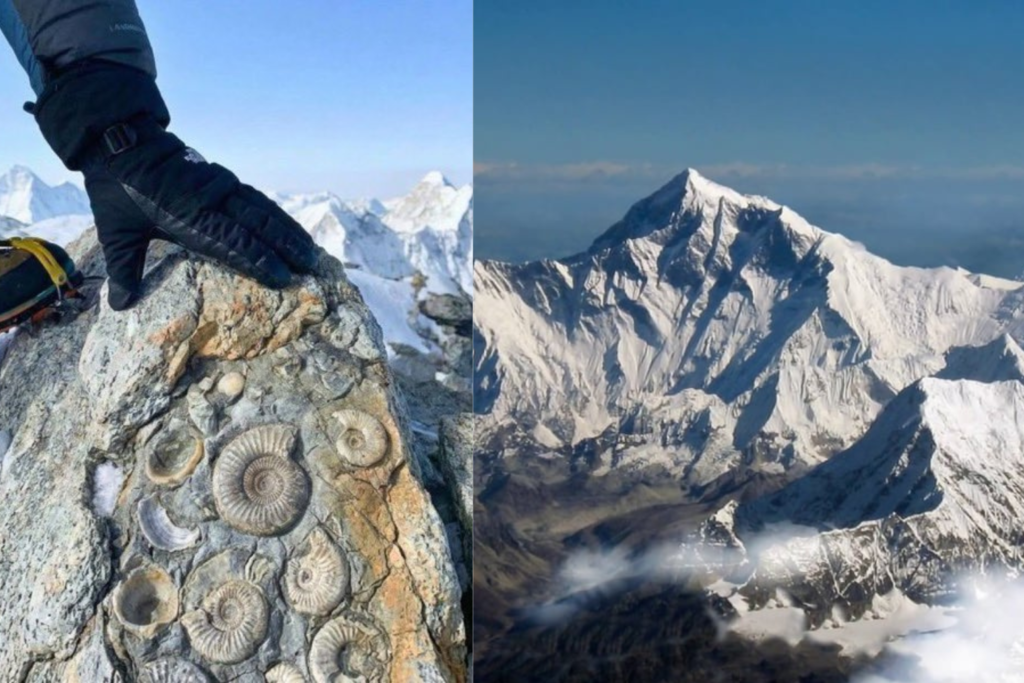
Mount Everest is known as the tallest mountain on Earth, rising high above the clouds in the Himalayas. But deep inside its rocks lies an unexpected secret from a very different time in Earth’s history. Scientists studying the mountain have found fossils of ancient sea animals near its summit, revealing that the area where Everest stands today was once covered by a vast ocean millions of years ago.
Mount Everest rocks reveal sea fossils:
Scientists have discovered fossils of ancient sea animals near the top of Mount Everest, the highest mountain on Earth. The fossils belong to marine creatures that lived about 450 million years ago, showing that the region where Everest stands today was once covered by an ocean. The fossils were found in special rocks called limestone, known as the Qomolangma Limestone, which formed on the floor of an ancient ocean called the Tethys Ocean.
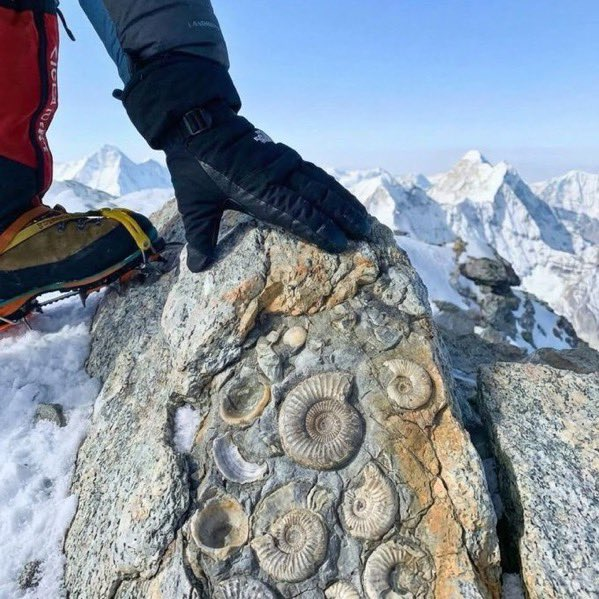
Scientists have discovered fossils of sea animals such as trilobites, brachiopods and crinoids inside these rocks. Geologists studying the Himalayas, including Dr. Paul Myrow and other researchers, have examined these rocks to understand how the mountains formed. Their research has been published in scientific journals such as Palaeogeography, Palaeoclimatology, Palaeoecology, which study Earth’s ancient environments. Scientists explain that about 50 million years ago, the Indian tectonic plate collided with the Eurasian plate.
This huge collision pushed the ancient seabed upward and slowly formed the Himalayan mountains, lifting the sea rocks and fossils thousands of metres above sea level. Today, these fossils high on Mount Everest help scientists learn how Earth’s continents move and how mountains form over millions of years.
Subscribe to The Junior Age Newspaper – click here. Know more fun facts on The Junior Age’s YouTube!