
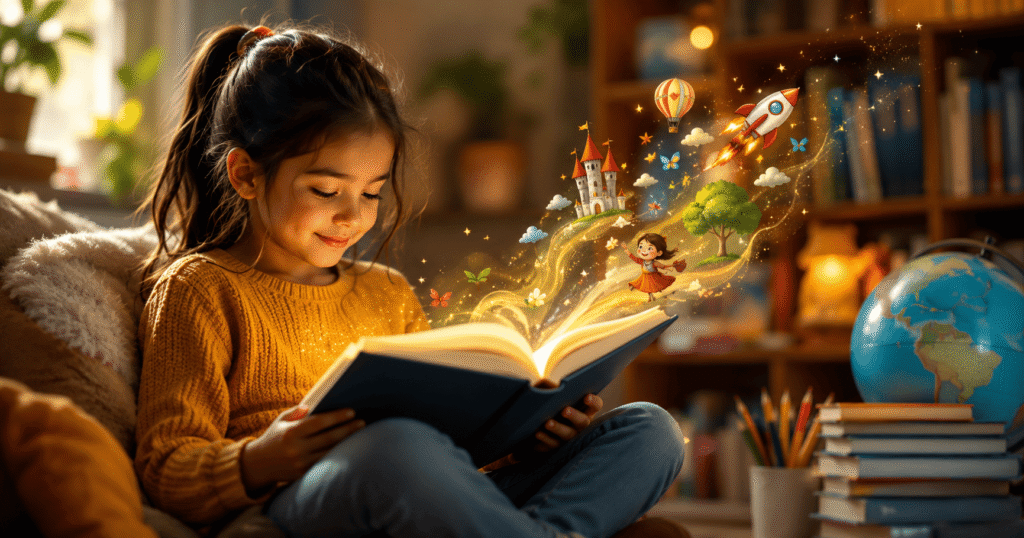
A few weeks ago, I watched my niece curl up on the couch with a picture book, and something about the way she went completely still made me stop and pay attention. No fidgeting, no reaching for a tablet, just her and the story. It got me thinking about how rare that kind of quiet focus has become, and how much good it’s actually doing for kids without them ever realising it. We keep hearing that children today have endless entertainment at their fingertips, and sure, a lot of it does teach them something. But nothing I’ve come across replaces what happens when a child sits with a short story for fifteen or twenty minutes a day. It’s such a small thing to ask of a day, and yet it quietly reshapes so much.
It Builds Real Reading Skills Without Feeling Like Work
Here’s what I find fascinating: kids don’t set out to improve their vocabulary. They just want to know what happens next. But that’s exactly what’s happening beneath the surface.
Every new word they stumble over and every unfamiliar sentence they puzzle through, is quietly making them a stronger reader. Their pronunciation improves. Their comprehension deepens. And little by little, they start sounding, and feeling like confident readers and communicators.
None of this happens, though, if the story doesn’t grab them in the first place. That’s really the whole game: finding stories a child actually wants to finish. Age-appropriate short stories that spark a sense of wonder do double duty, pulling kids in emotionally while introducing new language almost unnoticed. If you’re hunting for a good place to start, Kids World Fun’s Short Stories section has a nice range worth browsing.
It Wakes Up Their Imagination
Something I love about stories is that they hand a child a whole world for free, new characters to root for, new places to imagine, and new adventures to follow. There’s no screen doing the visualising for them. Their own mind has to build it. That’s a real workout for the imagination, and it pays off in ways you wouldn’t expect, like sharper problem-solving and more original thinking, both in the classroom and beyond.
I’ve noticed something else too, almost every time. A child who falls in love with stories eventually wants to tell their own. Maybe it starts as a scribbled drawing with a made-up caption, or a wild bedtime tale they insist on narrating themselves. Either way, that spark, wanting to create rather than just consume, is often where a genuine, lasting love of reading really begins.
It Sneaks In Life’s Bigger Lessons
Try telling a seven-year-old to be honest and watch it go in one ear and out the other. Now put that same idea inside a story about a character they’ve grown to like, and suddenly it sticks.
Kindness, honesty, responsibility, courage, empathy, and perseverance all have a greater impact when a child experiences them through someone they care about, rather than hearing them as a rule from an adult.
It’s also a wonderful excuse for real conversation. Reading a story together naturally opens the door to talking about difficult choices, seeing things from someone else’s perspective, and figuring out what doing the right thing actually looks like.
It Trains Their Focus, Quietly
Most digital entertainment is built to move fast and reward instantly, with quick cuts, quick wins, and constant stimulation. Reading asks for something different: patience.
A child has to sit with a story, follow where it’s going, remember who’s who, and connect the dots as events unfold. That kind of sustained attention doesn’t come naturally at first, but it builds bit by bit, and it’s exactly the skill that serves children so well once they’re sitting in a classroom.
A simple routine helps here more than people expect. Reading before bed or right after school doesn’t have to be elaborate. It’s less about discipline and more about giving children something to look forward to that also happens to be good for them.
Also, read about: Best 10 Bookstores in Mumbai for Kids: A Wonderland of Reading Delight
It Turns Learning Into Something Fun
Nobody, child or adult, learns particularly well when it feels like a chore. So once a story wraps up, that’s the perfect moment to keep the momentum going with a quick quiz, a puzzle, a vocabulary game, or anything that connects back to what they just read.
This is where educational games for kids really earn their keep. They reinforce memory, sharpen logical thinking, and build problem-solving and language skills, all while feeling more like play than practice. Kids World Fun’s short has a good range of these that blends the two nicely.
It Pays Off Academically, Too
This part isn’t just a hunch. Research backs it up consistently. Children who read regularly tend to perform better in language arts, and that advantage often carries over into other subjects as well. Reading sharpens critical thinking, broadens general knowledge, and makes it noticeably easier for children to follow instructions and reason through problems.
Perhaps the bigger benefit, though, is what it does for a child’s independence. Children who genuinely enjoy reading tend to become self-directed learners, and that’s a quality that continues to pay dividends long after any single subject or school year.
A Few Things That Actually Help
- Set up a cosy little reading corner at home or in the classroom.
- Let children choose their own stories. Interest beats assignment every time.
- Read together sometimes, and talk about what happened and why.
- Ask them to retell the story in their own words afterwards.
- Pair the story with a small game or activity whenever you can.
- Celebrate milestones, even the small ones, to keep them motivated.
And, know about: 10+ Best Bookshops for Children in Delhi NCR
Where This Leaves Us
You don’t need to carve out hours for this. A few unhurried minutes with a good story on most days is genuinely enough to shape a child’s language, creativity, confidence, and appetite for learning, and those benefits tend to last well beyond childhood.
Add a little playful activity into the mix, and you’re giving children everything they need: the knowledge to grow and the curiosity to keep going. Of all the things we can do for the children in our lives, this might be one of the easiest, and it still ranks among the most meaningful.
Also read about: 10 Amazing Children’s Books You Might Have Missed In 2025
Subscribe to The Junior Age Newspaper – click here. Know more fun facts on The Junior Age’s YouTube!