
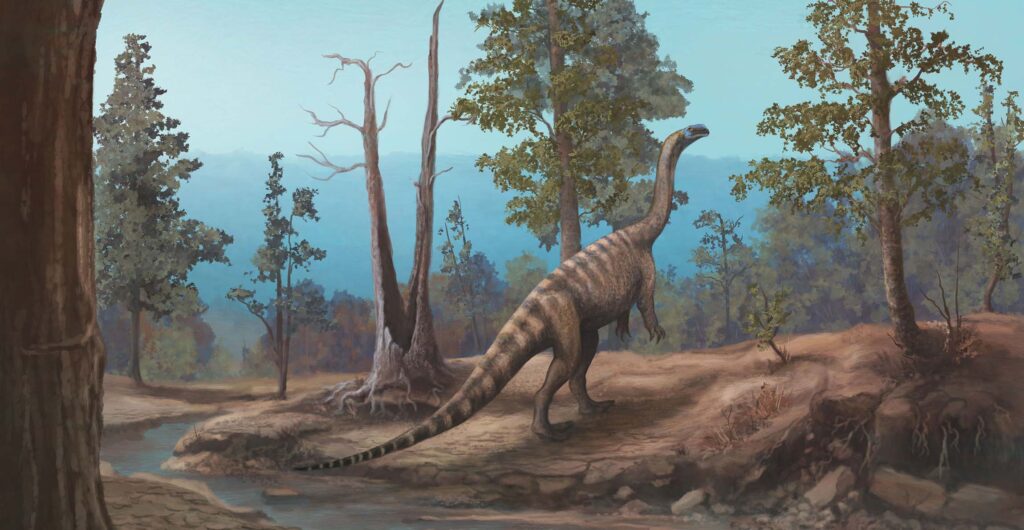
Millions of years before humans walked the Earth, dinosaurs roamed a giant landmass called Pangaea. Every new fossil discovery helps scientists uncover another piece of this ancient puzzle. Now, researchers have identified a brand new dinosaur species in Zimbabwe, offering exciting clues about how some of the world’s biggest dinosaurs first evolved. The newly discovered dinosaur, Musango matusadonaensis, lived around 210 million years ago and is only the fifth dinosaur species ever discovered in Zimbabwe.
Scientists discover a new dinosaur species in Zimbabwe
The discovery was made from fossilised leg bones found near Lake Kariba in northern Zimbabwe. After carefully studying the fossils, researchers confirmed that they belonged to a previously unknown dinosaur species.
The dinosaur has been named Musango matusadonaensis. Scientists believe it belonged to a group of early plant-eating dinosaurs called sauropodomorphs. These dinosaurs were the ancestors of the giant long-necked dinosaurs, including Brachiosaurus, that lived millions of years later. Researchers estimate that Musango stood about 1.5 metres tall at the hip and weighed around 390 kilograms. Although much smaller than its giant relatives, it was an important early member of the dinosaur family tree.
Why this discovery is important
The discovery suggests that southern Africa was already home to a wide variety of dinosaurs during the Late Triassic Period, earlier than many scientists had previously believed.
Experts say Africa may still hold many undiscovered fossils that could reveal how dinosaurs evolved and spread across the ancient supercontinent Pangaea. Every new fossil helps scientists better understand how these incredible animals adapted to different environments over millions of years. The research has been published in the Journal of Systematic Palaeontology.
What was the Late Triassic?
The Late Triassic Period lasted from about 230 million to 200 million years ago. It was an important time in Earth’s history because the first dinosaurs were spreading across the supercontinent Pangaea. Early dinosaurs were generally much smaller than the giant species that appeared later and lived alongside many other ancient reptiles and animals.
What was Pangaea?
Pangaea was a giant supercontinent that existed between about 300 million and 200 million years ago. Instead of the seven continents we know today, almost all of Earth’s land was joined together as one enormous landmass. Over millions of years, the movement of Earth’s tectonic plates caused Pangaea to slowly break apart, eventually forming today’s continents.
Also read about:
- Forgotten Fossil: Antarctica’s First Dinosaur Bone Discovered!
- Sahara Surprise: New Dinosaur as Big as T-Rex Unearthed
- Highest Number of Dinosaur Tracks Ever Found!
- Mini Mammal from the Age of Dinosaurs Discovered
- Some Interesting And Fun Dino Facts
Subscribe to The Junior Age Newspaper – click here. Know more fun facts on The Junior Age’s YouTube!