
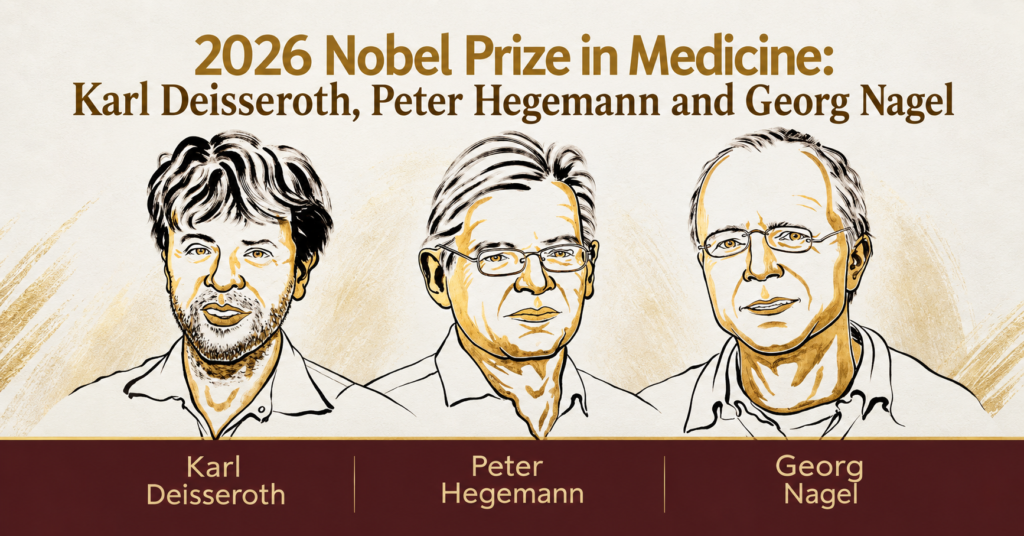
The 2026 Nobel Prize in Medicine has been awarded to Karl Deisseroth, Peter Hegemann and Georg Nagel for discoveries concerning light-gated ion channels and optogenetics. Their work has given scientists a way to use light to control specific nerve cells, helping researchers study how the brain works.
Karl Deisseroth, Peter Hegemann and Georg Nagel win 2026 Nobel Prize in Medicine
Karl Deisseroth, Peter Hegemann and Georg Nagel have won the 2026 Nobel Prize in Physiology or Medicine for discoveries concerning light-gated ion channels and optogenetics. The Nobel Assembly at Karolinska Institutet announced the prize on October 05, 2026. The three scientists will share prize money of 12 million Swedish kronor. Their work has given scientists a way to use light to switch individual nerve cells on or off in a living brain, helping researchers study how brain circuits work.
What is optogenetics?
Optogenetics is a technique that uses light-sensitive proteins to control the activity of specific nerve cells, or neurons.
Scientists can introduce these proteins into selected neurons and then use light to change their activity. This allows researchers to study particular groups of nerve cells with much greater precision.
The technique is now widely used in neuroscience laboratories around the world.

What did the three scientists discover?
Peter Hegemann and Georg Nagel
Peter Hegemann and Georg Nagel discovered channelrhodopsins, light-sensitive proteins found in single-celled organisms.
These proteins respond to light by allowing charged particles called ions to move across a cell membrane. Their discovery provided the key biological tool needed for later optogenetics research.
Karl Deisseroth
Karl Deisseroth helped turn this discovery into a powerful method for studying the brain. His research showed how light-sensitive proteins could be used in nerve cells, allowing scientists to control their activity with light. Together, these discoveries made it possible to investigate the role of individual nerve cells in a living brain.
2026 Nobel Prize in Medicine: Why does the discovery matter?
The brain contains billions of interconnected nerve cells. Understanding what different groups of neurons do is a major challenge for scientists.
Optogenetics allows researchers to:
- Switch selected nerve cells on or off.
- Study connections between groups of neurons.
- Investigate brain circuits linked to memories, feelings and behaviour.
- Study neurological and psychiatric conditions.
The technique is mainly a research tool, although scientists are also investigating possible medical applications.
Could it be used in medicine?
Researchers are studying whether optogenetics could eventually have medical uses, including applications related to neurological conditions and some forms of vision loss.
However, these applications are still being investigated. Optogenetics should not be confused with an established treatment for brain disorders.
Why is this a Nobel Prize-winning discovery?
The Nobel committee recognised how the three scientists’ work created a new way to study the brain. Peter Hegemann and Georg Nagel’s discoveries provided the light-sensitive proteins, while Karl Deisseroth helped develop their use for controlling nerve cells.
Their combined work led to optogenetics, giving scientists a precise new tool for investigating the living brain.
Fun fact: Optogenetics has its roots in single-celled organisms. A light-sensitive protein found in these tiny organisms became a key tool for studying the much more complex human brain.
FAQs on the 2026 Nobel Prize in Medicine
Who won the 2026 Nobel Prize in Medicine?
Karl Deisseroth, Peter Hegemann and Georg Nagel won the 2026 Nobel Prize in Physiology or Medicine.
Why did they win the Nobel Prize?
They were recognised for discoveries concerning light-gated ion channels and optogenetics.
What is optogenetics?
Optogenetics is a technique that uses light-sensitive proteins to control the activity of specific nerve cells.
What did Peter Hegemann and Georg Nagel discover?
They discovered light-sensitive proteins called channelrhodopsins in single-celled organisms.
What did Karl Deisseroth contribute?
Karl Deisseroth helped develop the use of light-sensitive proteins for controlling nerve cells and studying brain activity.
How does optogenetics help scientists?
It allows researchers to switch selected nerve cells on or off and study their role in brain circuits.
How much is the 2026 Nobel Prize worth?
The prize money is 12 million Swedish kronor, shared by the three laureates.
Also read about:
- Know The Nobel Prize 2025 Winners
- Nobel Prize 2024 Winners: Names, Fields, Prize Amount & Achievements
- 10 Indian Scientists Who Made History with Amazing Discoveries
Subscribe to The Junior Age Newspaper – click here. Know more fun facts on The Junior Age’s YouTube!