
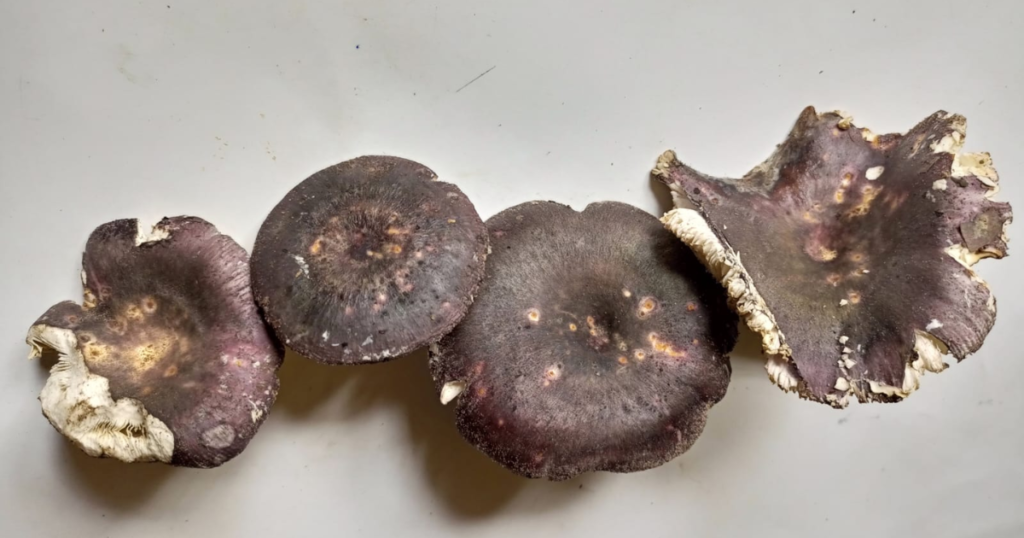
A mushroom collected in Meghalaya has turned out to be a species previously unknown to science. The discovery adds to our understanding of India’s rich fungal diversity and shows how even a small organism growing quietly beneath a tree can reveal something new about the natural world. The new species has been named Russula griseopurpurata and was identified by researchers from Gauhati University. The findings were published in the scientific journal Phytotaxa.
Scientists discover a new mushroom species in Meghalaya
The story began in July 2022, when researchers found the mushroom at Jirang in Ri-Bhoi district, Meghalaya, at an elevation of about 320 metres. It was growing beneath a sal tree, scientifically known as Shorea robusta.
At first glance, the mushroom might have looked like one of many fungi found in India’s forests. But closer examination revealed some unusual features. The mushroom has a greyish-purple cap that develops cracks as it matures. Its gills, the thin structures underneath the cap, have distinctive forkings near the stalk. Researchers also studied microscopic features that helped distinguish it from related mushrooms.
The researchers examined three specimens, including one from Meghalaya and two from West Bengal. They combined detailed observations of the mushrooms’ physical and microscopic characteristics with DNA sequencing and phylogenetic analysis. The genetic evidence supported the conclusion that the specimens belonged to a separate species.
What does Russula mean?
Russula is a large and diverse genus of mushrooms, with around 2,000 species known worldwide. More than 180 species have been documented in different parts of India. The new species has so far been recorded in Meghalaya and West Bengal, where the mushrooms were found singly or in scattered groups beneath sal trees. The name griseopurpurata refers to its distinctive greyish-purple colour. The Latin roots griseus and purpuratus describe the grey and purple shades seen on its cap.
Finding a new species is more than simply adding another name to a list. Scientists use discoveries like this to understand biodiversity, evolution and how different organisms are connected to their habitats. It also highlights how much there is still to learn about fungi. Forests contain an enormous variety of mushrooms and other fungi, many of which are tiny, seasonal or difficult to identify without careful scientific study.
FAQs
1. What is the new mushroom species discovered in Meghalaya?
It is called Russula griseopurpurata.
2. Where was it first found?
The mushroom was collected at Jirang in Ri-Bhoi district, Meghalaya, in July 2022.
3. What does the new mushroom look like?
It has a greyish-purple cap that develops cracks as it matures. Its gills also have distinctive forkings near the stalk.
4. How did scientists confirm it was a new species?
Researchers studied its physical and microscopic features and used DNA sequencing and phylogenetic analysis to compare it with related mushrooms.
5. Can you eat Russula griseopurpurata?
Its edibility has not been established, so it should not be considered safe to eat.
Also read: Meghalaya’s Lakadong Turmeric Faces Climate Challenge Risk!
Subscribe to The Junior Age Newspaper – click here. Know more fun facts on The Junior Age’s YouTube!