
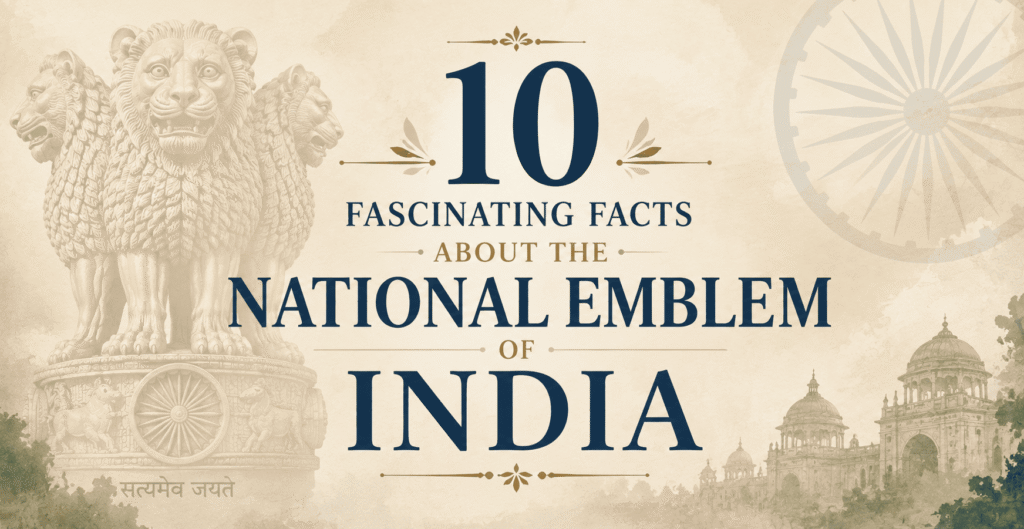
The National Emblem of India is one of the country’s most important national symbols. You can spot it on passports, currency notes, government buildings and official documents. Most people recognise the four lions, but very few know the fascinating history and hidden details behind the emblem. From ancient carvings to powerful symbols of truth and justice, every part of the National Emblem has a special meaning. Let’s discover some lesser-known facts about the National Emblem of India.
What is the National Emblem of India?
The National Emblem of India is an adaptation of the Lion Capital of Ashoka, a sandstone sculpture built by Emperor Ashoka at Sarnath in present-day Uttar Pradesh around 250 BCE. It was officially adopted on January 26, 1950, the day India became a republic.
Lesser-known facts about the National Emblem of India
1. Only three lions are visible
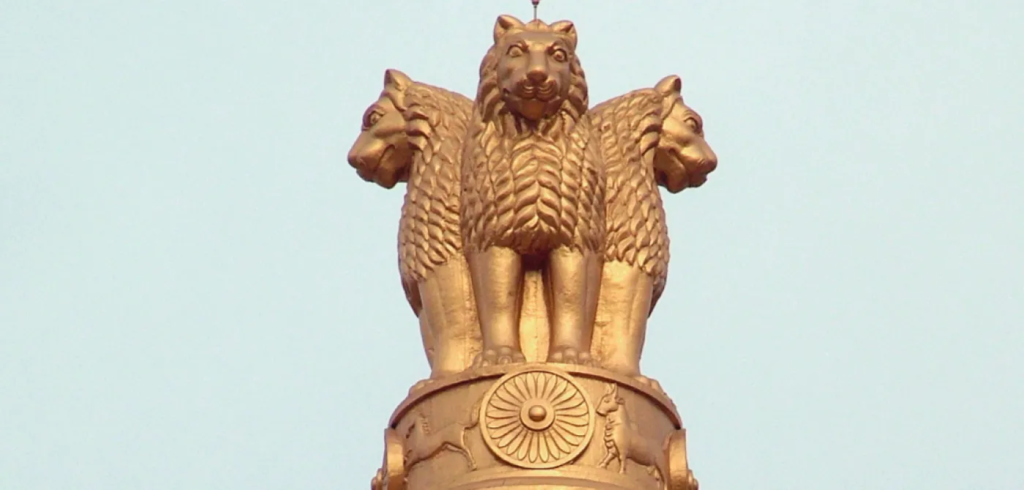
The emblem has four Asiatic lions, but from the front, only three can be seen. The fourth lion stands at the back and is hidden from view.
2. The original sculpture has four animals
Many people think the emblem only has lions, a bull and a horse. In fact, the original Lion Capital of Ashoka also includes an elephant and another lion carved on the circular base. These are not visible in the official two-dimensional version of the National Emblem.
3. The Ashoka Chakra appears twice
The Ashoka Chakra is not only found on the National Flag. It also appears on the circular base of the National Emblem, between the animal carvings. The wheel symbolises justice, righteousness and continuous progress.
4. It is more than 2,200 years old
Although the National Emblem was adopted in 1950, the original Lion Capital dates back to around 250 BCE, making its design more than 2,200 years old.
5. It was built by Emperor Ashoka
The Lion Capital was created during the reign of Emperor Ashoka after he embraced Buddhism. He built pillars across his empire to spread messages of peace, kindness and good governance.
6. The motto comes from an ancient scripture
The words Satyameva Jayate, meaning Truth Alone Triumphs, are written below the emblem. They come from the Mundaka Upanishad, one of India’s ancient Sanskrit texts.
7. It is carved from a single block of stone
The original Lion Capital at Sarnath was carved from a single piece of polished sandstone, showcasing the remarkable craftsmanship of ancient Indian sculptors.
8. It is India’s official symbol of authority
The National Emblem represents the Government of India. It appears on official documents, passports, court seals, government buildings and the official letterheads of ministries and departments.
9. The original is kept in a museum
The original Lion Capital is preserved at the Sarnath Archaeological Museum near Varanasi, where visitors can see the sculpture that inspired India’s National Emblem.
10. The emblem cannot be used freely
The National Emblem is protected under The State Emblem of India (Prohibition of Improper Use) Act, 2005. Its use is restricted to authorised government bodies and approved purposes. Individuals and businesses cannot use it as a logo or for advertising without permission.
Did you know?
- The original Lion Capital is about 2.1 metres tall, including the lotus-shaped base.
- The National Emblem appears on every Indian passport.
- The Ashoka Chakra has 24 spokes, representing continuous movement and progress.
- The four lions face the four directions, symbolising vigilance and leadership.
Frequently asked questions about the National Emblem of India
1. What is the National Emblem of India?
Answer: The National Emblem of India is an adaptation of the Lion Capital of Ashoka at Sarnath. It was adopted on January 26, 1950.
2. Why are only three lions visible in the National Emblem?
Answer: The original sculpture has four lions standing back to back. In the official front view, only three lions can be seen, while the fourth remains hidden at the back.
3. What does Satyameva Jayate mean?
Answer: It means Truth Alone Triumphs. The phrase comes from the Mundaka Upanishad and appears below the National Emblem.
4. Where is the original Lion Capital kept?
Answer: The original Lion Capital is preserved at the Sarnath Archaeological Museum in Uttar Pradesh.
5. Can anyone use the National Emblem of India?
Answer: No. The National Emblem is protected by law and can only be used by authorised government organisations and for approved official purposes.
6. What does the Ashoka Chakra on the National Emblem represent?
Answer: The Ashoka Chakra symbolises justice, righteousness and continuous progress.
7. Who built the original Lion Capital?
Answer: Emperor Ashoka built the Lion Capital around 250 BCE at Sarnath.
8. What animals appear on the original Lion Capital?
Answer: The original sculpture features four lions at the top and carvings of an elephant, bull, horse and lion on the circular base, separated by Ashoka Chakras.
You may also like to read:
- National Symbols of India Explained for Kids
- Top 50: The Firsts of India Every Child Should Know!
- Ultimate Patriotic Movies To Watch With Kids
- The Jallianwala Bagh Massacre: A Story Every Child Should Know
- Subhas Chandra Bose: Life, Struggle, and Legacy of Netaji
- All You Need To Know About The Key Figures in India’s Freedom Struggle
- Everything You Need To Know About India’s Republic Day
- Everything You Need To Know About The Constitution Of India
- Independent India’s Historic Milestones
Also, learn all about India with – Exploring India Flash Cards
Subscribe to The Junior Age Newspaper – click here. Know more fun facts on The Junior Age’s YouTube!