
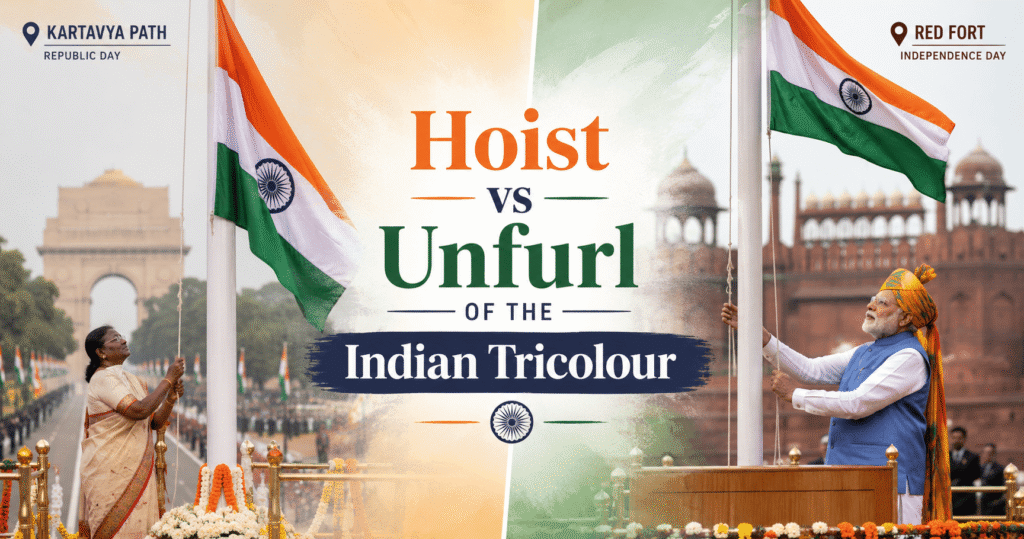
Every year, two national celebrations fill India with the colours of the Indian Tricolour: Independence Day on August 15 and Republic Day on January 26. Both feature the national flag, but there is an important difference in who leads the main ceremony and how the flag is displayed. On Independence Day, the Prime Minister leads the ceremony at the Red Fort in New Delhi. On Republic Day, the President leads the ceremonial unfurling of the Indian Tricolour at Kartavya Path before the grand parade. But why is there this difference? The answer lies in two milestones in India’s history: gaining independence in 1947 and becoming a republic in 1950.
Why the Prime Minister hoists the Indian Tricolour on Independence Day:
On 15 August 1947, India became free from British rule. It was the people of India, through decades of struggle, sacrifice, and protest, who won this freedom. The people elect the Prime Minister and represent their will and voice in a democratic government. So when India marks the day it gained freedom, it is only fitting that the Prime Minister, as the people’s representative, raises the flag from the ground up.
- The flag rising from the bottom to the top symbolises a new nation rising from colonial rule.
- The Red Fort was chosen as the venue because it was a seat of Mughal and British power; reclaiming it was itself a statement of independence.
- The act honours the countless freedom fighters who made the moment possible.
It is worth noting that on the very first Independence Day in 1947, India did not yet have a President. Lord Mountbatten was still the Governor General. The Prime Minister hoisted the flag then, and the tradition has continued ever since.
Why the President unfurls the Indian Tricolour on Republic Day:
By 26 January 1950, India was already a free country. What changed on that day was that India gave itself a Constitution, a set of rules and values that made India a republic, promising justice, liberty, and equality to every citizen. The President of India is the constitutional head of state, the guardian of the Constitution and its values.
- The flag is already aloft, because India is already free, there is nothing left to raise.
- The President unfolds it from above, symbolising that the promises of the Constitution are being opened up and offered to all citizens.
- Flowers tucked inside the folded flag spill into the air as it opens, a tradition that adds to the beauty of the moment.
- Kartavya Path serves as the venue, where the grand parade of India’s armed forces, states, and cultural diversity follows the flag ceremony.
Hoisting vs unfurling of the Indian Tricolour
This is where confusion often happens.
- Hoisting: raising the flag from the bottom of the pole
- Unfurling: opening a flag already placed at the top
Independence Day represents a new beginning, so the flag is hoisted.
Republic Day represents an already established nation, so the flag is unfurled.
Today, the difference is mostly symbolic, but the tradition remains important.
Why was there no President in 1947?
India became independent in 1947 but was not yet a republic. The office of the President was created only after the Constitution came into force in 1950. Dr Rajendra Prasad became the first President of India.
FAQs – Why PM Hoists the Tricolour on Independence Day, But President Unfurls It on Republic Day
1. Who hoists the Indian Tricolour on Independence Day?
The Prime Minister of India hoists the Indian Tricolour at the Red Fort in New Delhi.
2. Who unfurls the Indian Tricolour on Republic Day?
The President of India unfurls the Indian Tricolour at Kartavya Path in New Delhi.
3. Why is Republic Day celebrated on January 26?
Because the Constitution of India came into effect on January 26, 1950.
4. Was India a republic in 1947?
No. India became independent in 1947 but became a republic in 1950.
5. Who was the first President of India?
Dr Rajendra Prasad was the first President of India.
6. Did India always follow this tradition of the PM hoisting and the President unfurling?
Not from the very beginning. On the first Independence Day in 1947, India did not yet have a President, so Prime Minister Jawaharlal Nehru hoisted the flag. When India became a republic in 1950 and the position of President was established, the tradition of the President unfurling the flag on Republic Day began and has continued since.
You may also like to read:
- National Symbols of India Explained for Kids
- Quit India Movement 1942 Explained for Kids: History, Causes and Impact
- Top 50: The Firsts of India Every Child Should Know!
- Ultimate Patriotic Movies To Watch With Kids
- The Jallianwala Bagh Massacre: A Story Every Child Should Know
- Subhas Chandra Bose: Life, Struggle, and Legacy of Netaji
- All You Need To Know About The Key Figures in India’s Freedom Struggle
- Everything You Need To Know About India’s Republic Day
- Everything You Need To Know About The Constitution Of India
- Independent India’s Historic Milestones
- Indian Freedom Movement Slogans: Who Said Them & What They Mean
Also, learn all about India with – Exploring India Flash Cards
Subscribe to The Junior Age Newspaper – click here. Know more fun facts on The Junior Age’s YouTube!