
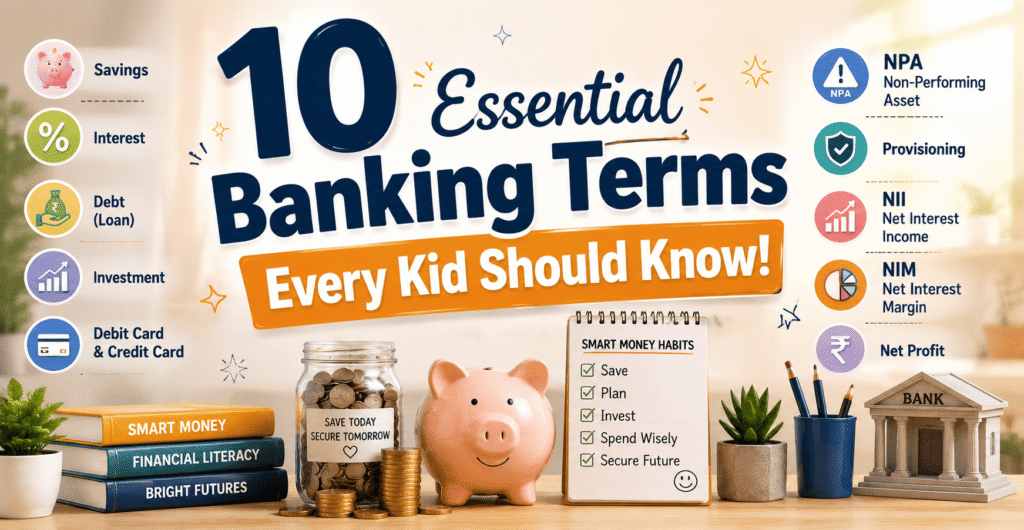
Money is a part of everyday life. Children see their parents shopping with cards, scanning QR codes, saving money in banks and even talking about loans or interest. But do they know what these words actually mean? Understanding banking terms is an important step towards building financial literacy. When children learn simple banking concepts from an early age, they become more confident about managing money, making smart spending decisions and understanding how banks work. In this guide, The Junior Age will easily explain 10 essential banking terms. Whether your child is curious about saving money or has heard banking words in the news, these easy explanations will help them understand the basics of banking.
Why should children learn banking terms?
Banks play an important role in our daily lives. They help people save money, borrow money, make payments and even grow their wealth. Learning banking terms helps children:
- Build healthy money habits.
- Understand how banks work.
- Improve financial literacy.
- Feel more confident during quizzes and classroom discussions.
- Make smarter financial decisions as they grow.
Let’s explore the most important banking terms every child should know.
10 banking terms every child should know
1. Savings
What does it mean?
Savings means keeping some money aside instead of spending it immediately. Children can save money from their pocket money, birthday gifts or rewards to buy something they really want in the future.
Example: If Riya receives ₹500 for her birthday and spends only ₹200, she can save ₹300 for a new storybook.
Why is it important?
- Helps achieve future goals.
- Teaches patience.
- Builds responsible money habits.
2. Interest
What does it mean?
Interest is extra money.
- When you save money in a bank, the bank may pay you interest as a reward.
- When you borrow money from a bank, you usually have to pay interest for using that money.
Simple example: If you save ₹1,000 in a bank, after some time you may receive a little extra money called interest.
3. Debt (Loan)
What does it mean?
A loan is money borrowed from a bank or another person that must be paid back, usually with interest. People may take loans to buy:
- A house
- A car
- Pay for education
- Start a business
Kid-friendly tip: Borrow only when necessary and always repay what you owe.
4. Investment
What does it mean?
An investment means putting money into something with the hope that it will grow over time. People invest in things such as:
- Mutual funds
- Shares
- Gold
- Fixed deposits
Unlike savings, investments can offer higher returns, but they may also involve some risk.
5. Debit card and credit card
Children often see both cards but may not know the difference.
| Debit Card | Credit Card |
|---|---|
| Uses your own money from your bank account. | Uses money borrowed from the bank. |
| You can only spend what you have. | You can spend first and pay later. |
| No borrowing involved. | Borrowing is involved, so repayment is important. |
Easy way to remember: Debit = Your money | Credit = Borrowed money
6. Non-Performing Asset (NPA)
What does it mean?
An NPA, or Non-Performing Asset, is a loan that the borrower has stopped repaying for a long time. In simple words, the bank gave someone money, but they are not paying it back as agreed.
Why does it matter?
- Banks lose income.
- Less money is available to lend to others.
- Too many NPAs can affect a bank’s financial health.
This is one of the most commonly heard banking terms in business news.
7. Provisioning
What does it mean?
Provisioning means keeping some money aside to prepare for possible losses. Imagine you lend your friend ₹500 and you’re worried they may not return it. So, you keep some extra money saved just in case. Banks do something similar.
Why do banks do this?
- To stay financially strong.
- To prepare for loans that may not be repaid.
- To protect customers’ money.
8. Net Interest Income (NII)
What does it mean?
Net Interest Income, or NII, is the money a bank earns from lending after subtracting the interest it pays to people who keep money in savings accounts and fixed deposits.
Simple example:
- A bank earns ₹100 as interest from loans.
- It pays ₹40 as interest to customers.
- The remaining ₹60 is its Net Interest Income.
A higher NII usually means the bank is earning more from its core banking business.
9. Net Interest Margin (NIM)
What does it mean?
Net Interest Margin, or NIM, tells us how efficiently a bank earns money from the loans it gives. Think of it as a score that shows how well a bank is using its money to earn income. A healthy NIM generally means the bank is managing its lending business efficiently.
10. Net Profit
What does it mean?
Net Profit is the money a bank has left after paying all its expenses, salaries, taxes and other costs. It shows whether the bank has made a profit or a loss.
Simple example
If a bank earns ₹1,000 and spends ₹800, its Net Profit is ₹200. When you hear that a bank has announced its quarterly results, Net Profit is one of the biggest numbers people look at.
How do banking terms help children?
Understanding banking terms helps children:
- Become financially responsible.
- Learn the value of saving.
- Understand news about banks and the economy.
- Improve General Knowledge.
- Build confidence in handling money as they grow.
The earlier children learn these concepts, the easier it becomes to make smart financial decisions in adulthood.
Did you know?
- Banks in India are regulated by the Reserve Bank of India (RBI), which is the country’s central bank.
- Many business news reports about banks mention NPA, NII, NIM and Net Profit because these figures help show how well a bank is performing.
- Every time you save money in a bank account, your money can help the bank lend to other people and businesses.
FAQs about banking terms
What are banking terms?
Answer: Banking terms are words used to explain how banks work and how people save, borrow and manage money.
Why should children learn banking terms?
Answer: Learning banking terms helps children build financial literacy, understand money better and make smarter financial decisions.
What is the difference between savings and investment?
Answer: Savings means keeping money safe for future use, while an investment is money put into something with the aim of growing it over time.
What is an NPA in simple words?
Answer: An NPA is a loan that has not been repaid for a long time, making it difficult for the bank to recover its money.
Why do banks announce Net Profit every quarter?
Answer: Net Profit shows how much money a bank has earned after paying all its expenses, making it an important measure of financial performance.
Keep learning with The Junior Age
Money skills are life skills. The more children understand about banking terms, saving and smart financial choices, the more confident they become about managing money in the future. At The Junior Age, we make complex topics simple through engaging explainers, current affairs, quizzes and fun learning resources that spark curiosity and build lifelong knowledge.
Also read about:
- World Countries and Their Currencies: Ultimate GK Guide for Students
- AI for Studies: The 15+ Best Tools to Boost Your Learning Success
Subscribe to The Junior Age Newspaper – click here. Know more fun facts on The Junior Age’s YouTube!