
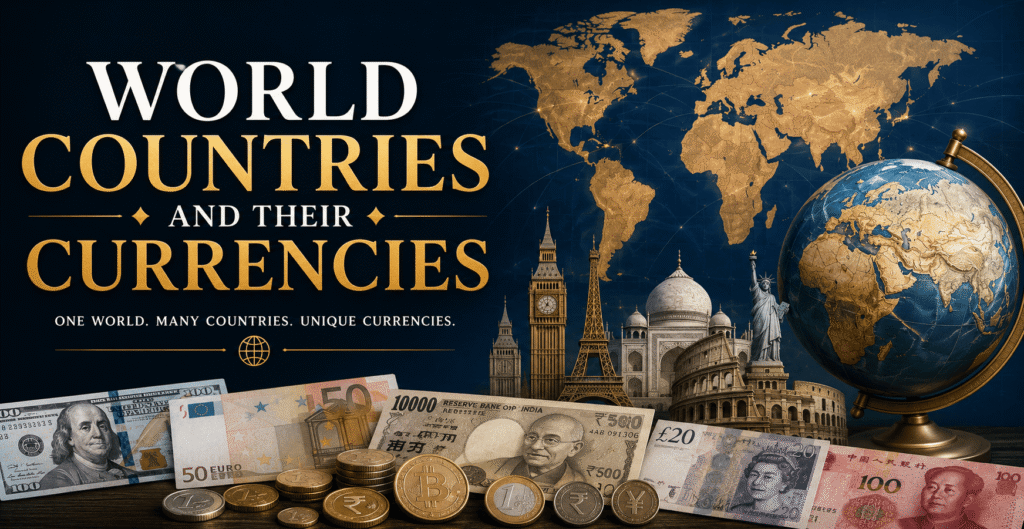
Have you ever wondered why people in India use the rupee, while people in Japan use the yen or those in the United States use the dollar? Every country has its own way of buying and selling goods, and that’s where countries and their currencies come in. A currency is the official money used in a country. It helps people pay for everyday things like food, clothes, books and toys. While many countries have their own unique currency, some share the same one. For example, 21 European Union countries use the euro as their official currency.
Learning about countries and their currencies is an important part of General Knowledge (GK). It also helps you understand world geography, travel, business, history and current affairs. Whether you’re preparing for a quiz, school exam or simply love discovering new facts, this guide will make learning easy and fun. Let’s explore how currencies work before diving into the complete list of world countries and their currencies.
What is a currency?
A currency is the official money that a country uses to buy and sell goods and services. It can be in the form of:
- Coins
- Banknotes (paper money)
- Digital money used through banks and online payments
Without a common currency, shopping and trade would become very difficult.
Why do countries have different currencies?
Every country manages its own economy. Having its own currency allows a government and central bank to:
- Control prices and inflation
- Support businesses and jobs
- Manage imports and exports
- Decide interest rates
- Keep the country’s economy stable
Some neighbouring countries choose to share one currency. The best-known example is the euro, which is used by 21 European Union countries.
Knowing the stories behind currency names makes learning GK even more interesting. Here is a list of all the countries and their currencies:
Countries and their currencies (A to G)
| Country | Currency |
|---|---|
| Afghanistan | Afghan Afghani |
| Albania | Albanian Lek |
| Algeria | Algerian Dinar |
| Andorra | Euro |
| Angola | Angolan Kwanza |
| Antigua and Barbuda | East Caribbean Dollar |
| Argentina | Argentine Peso |
| Armenia | Armenian Dram |
| Australia | Australian Dollar |
| Austria | Euro |
| Azerbaijan | Azerbaijani Manat |
| Bahamas | Bahamian Dollar |
| Bahrain | Bahraini Dinar |
| Bangladesh | Bangladeshi Taka |
| Barbados | Barbados Dollar |
| Belarus | Belarusian Ruble |
| Belgium | Euro |
| Belize | Belize Dollar |
| Benin | West African CFA Franc |
| Bhutan | Bhutanese Ngultrum |
| Bolivia | Boliviano |
| Bosnia and Herzegovina | Convertible Mark |
| Botswana | Botswana Pula |
| Brazil | Brazilian Real |
| Brunei | Brunei Dollar |
| Bulgaria | Euro |
| Burkina Faso | West African CFA Franc |
| Burundi | Burundian Franc |
| Cabo Verde | Cape Verdean Escudo |
| Cambodia | Cambodian Riel |
| Cameroon | Central African CFA Franc |
| Canada | Canadian Dollar |
| Central African Republic | Central African CFA Franc |
| Chad | Central African CFA Franc |
| Chile | Chilean Peso |
| China | Renminbi (Yuan) |
| Colombia | Colombian Peso |
| Comoros | Comorian Franc |
| Congo (Republic of the Congo) | Central African CFA Franc |
| Costa Rica | Costa Rican Colón |
| Côte d’Ivoire | West African CFA Franc |
| Croatia | Euro |
| Cuba | Cuban Peso |
| Cyprus | Euro |
| Czech Republic | Czech Koruna |
| Democratic Republic of the Congo | Congolese Franc |
| Denmark | Danish Krone |
| Djibouti | Djiboutian Franc |
| Dominica | East Caribbean Dollar |
| Dominican Republic | Dominican Peso |
| Ecuador | United States Dollar |
| Egypt | Egyptian Pound |
| El Salvador | United States Dollar |
| Equatorial Guinea | Central African CFA Franc |
| Eritrea | Eritrean Nakfa |
| Estonia | Euro |
| Eswatini | Lilangeni |
| Ethiopia | Ethiopian Birr |
| Fiji | Fijian Dollar |
| Finland | Euro |
| France | Euro |
| Gabon | Central African CFA Franc |
| Gambia | Gambian Dalasi |
| Georgia | Georgian Lari |
| Germany | Euro |
| Ghana | Ghanaian Cedi |
| Greece | Euro |
| Grenada | East Caribbean Dollar |
| Guatemala | Guatemalan Quetzal |
| Guinea | Guinean Franc |
| Guinea-Bissau | West African CFA Franc |
| Guyana | Guyanese Dollar |
Countries and Their Currencies (H to N)
| Country | Currency |
|---|---|
| Haiti | Haitian Gourde |
| Honduras | Honduran Lempira |
| Hungary | Hungarian Forint |
| Iceland | Icelandic Króna |
| India | Indian Rupee |
| Indonesia | Indonesian Rupiah |
| Iran | Iranian Rial |
| Iraq | Iraqi Dinar |
| Ireland | Euro |
| Israel | Israeli New Shekel |
| Italy | Euro |
| Jamaica | Jamaican Dollar |
| Japan | Japanese Yen |
| Jordan | Jordanian Dinar |
| Kazakhstan | Kazakhstani Tenge |
| Kenya | Kenyan Shilling |
| Kiribati | Australian Dollar |
| Kuwait | Kuwaiti Dinar |
| Kyrgyzstan | Kyrgyzstani Som |
| Laos | Lao Kip |
| Latvia | Euro |
| Lebanon | Lebanese Pound |
| Lesotho | Lesotho Loti |
| Liberia | Liberian Dollar |
| Libya | Libyan Dinar |
| Liechtenstein | Swiss Franc |
| Lithuania | Euro |
| Luxembourg | Euro |
| Madagascar | Malagasy Ariary |
| Malawi | Malawian Kwacha |
| Malaysia | Malaysian Ringgit |
| Maldives | Maldivian Rufiyaa |
| Mali | West African CFA Franc |
| Malta | Euro |
| Marshall Islands | United States Dollar |
| Mauritania | Mauritanian Ouguiya |
| Mauritius | Mauritian Rupee |
| Mexico | Mexican Peso |
| Micronesia | United States Dollar |
| Moldova | Moldovan Leu |
| Monaco | Euro |
| Mongolia | Mongolian Tögrög |
| Montenegro | Euro |
| Morocco | Moroccan Dirham |
| Mozambique | Mozambican Metical |
| Myanmar | Myanmar Kyat |
| Namibia | Namibian Dollar |
| Nauru | Australian Dollar |
| Nepal | Nepalese Rupee |
| Netherlands | Euro |
| New Zealand | New Zealand Dollar |
| Nicaragua | Nicaraguan Córdoba |
| Niger | West African CFA Franc |
| Nigeria | Nigerian Naira |
| North Korea | North Korean Won |
| North Macedonia | Macedonian Denar |
| Norway | Norwegian Krone |
Countries and Their Currencies (O to Z)
| Country | Currency |
|---|---|
| Oman | Omani Rial |
| Pakistan | Pakistani Rupee |
| Palau | United States Dollar |
| Palestine | Israeli New Shekel* |
| Panama | Panamanian Balboa and United States Dollar |
| Papua New Guinea | Papua New Guinean Kina |
| Paraguay | Paraguayan Guaraní |
| Peru | Peruvian Sol |
| Philippines | Philippine Peso |
| Poland | Polish Złoty |
| Portugal | Euro |
| Qatar | Qatari Riyal |
| Romania | Romanian Leu |
| Russia | Russian Ruble |
| Rwanda | Rwandan Franc |
| Saint Kitts and Nevis | East Caribbean Dollar |
| Saint Lucia | East Caribbean Dollar |
| Saint Vincent and the Grenadines | East Caribbean Dollar |
| Samoa | Samoan Tālā |
| San Marino | Euro |
| São Tomé and Príncipe | Dobra |
| Saudi Arabia | Saudi Riyal |
| Senegal | West African CFA Franc |
| Serbia | Serbian Dinar |
| Seychelles | Seychellois Rupee |
| Sierra Leone | Sierra Leonean Leone |
| Singapore | Singapore Dollar |
| Slovakia | Euro |
| Slovenia | Euro |
| Solomon Islands | Solomon Islands Dollar |
| Somalia | Somali Shilling |
| South Africa | South African Rand |
| South Sudan | South Sudanese Pound |
| Spain | Euro |
| Sri Lanka | Sri Lankan Rupee |
| Sudan | Sudanese Pound |
| Suriname | Surinamese Dollar |
| Sweden | Swedish Krona |
| Switzerland | Swiss Franc |
| Syria | Syrian Pound |
| Taiwan | New Taiwan Dollar |
| Tajikistan | Tajikistani Somoni |
| Tanzania | Tanzanian Shilling |
| Thailand | Thai Baht |
| Timor-Leste | United States Dollar |
| Togo | West African CFA Franc |
| Tonga | Tongan Paʻanga |
| Trinidad and Tobago | Trinidad and Tobago Dollar |
| Tunisia | Tunisian Dinar |
| Türkiye | Turkish Lira |
| Turkmenistan | Turkmenistani Manat |
| Tuvalu | Tuvaluan Dollar and Australian Dollar |
| Uganda | Ugandan Shilling |
| Ukraine | Ukrainian Hryvnia |
| United Arab Emirates | UAE Dirham |
| United Kingdom | Pound Sterling |
| United States | United States Dollar |
| Uruguay | Uruguayan Peso |
| Uzbekistan | Uzbekistani Soʻm |
| Vanuatu | Vanuatu Vatu |
| Vatican City | Euro |
| Venezuela | Venezuelan Bolívar |
| Vietnam | Vietnamese Đồng |
| Yemen | Yemeni Rial |
| Zambia | Zambian Kwacha |
| Zimbabwe | Zimbabwe Gold (ZiG) and other foreign currencies |
Amazing Currency Facts
The world’s most valuable currency
The Kuwaiti Dinar (KWD) is widely regarded as one of the world’s highest-valued currencies.
The most widely used currency
The United States Dollar (USD) is the world’s most traded and widely accepted currency. It is also used officially by several countries outside the United States.
Why do some countries use the US dollar?
Some countries have chosen to use the United States dollar (USD) as their official currency instead of creating their own. This is called official dollarisation. Countries such as Ecuador, El Salvador, the Marshall Islands and Micronesia use the US dollar because it can help support trade, tourism and economic stability.
Why do many European countries use the euro?
The euro (€) is one of the world’s most widely used currencies. It was introduced to make trade, travel and business easier between participating European countries. Today, 21 European Union countries use the euro, allowing people to travel and shop without exchanging money when moving between those nations.
Who prints a country’s money?
Most countries have a central bank, which is responsible for issuing banknotes, managing coins and helping keep the country’s economy stable.
Why do exchange rates change?
Currencies don’t always have the same value. Their prices change because of factors such as:
- Supply and demand
- Inflation
- Trade
- Interest rates
- Global events
This changing value is called the exchange rate.
Did You Know?
The symbols on banknotes often celebrate a country’s culture and history. You might find famous leaders, scientists, wildlife, monuments or national heroes featured on different currencies around the world.
Learning about countries and their currencies is more than memorising names. It helps you understand how the world works, how countries trade with one another and why money plays such an important role in everyday life.
FAQs About Countries and Their Currencies
Which country uses the Indian Rupee?
Answer: India uses the Indian Rupee (INR) as its official currency.
Which country has the highest-valued currency?
Answer: The Kuwaiti Dinar (KWD) is generally considered the highest-valued currency in the world based on its exchange rate.
How many countries use the euro?
Answer: As of 2026, 21 European Union countries use the euro as their official currency.
Why do different countries have different currencies?
Answer: Every country manages its own economy. Having its own currency helps control prices, trade, inflation and interest rates.
Which country uses the yen?
Answer: Japan uses the Japanese Yen (JPY).
Which country uses the pound sterling?
Answer: The United Kingdom uses Pound Sterling (GBP).
What is the most commonly used currency in the world?
Answer: The United States Dollar (USD) is the most widely traded and internationally used currency.
Why do some countries share the same currency?
Answer: Sharing a currency can make trade, travel and business easier between countries and reduce the cost of exchanging money.
Why is learning countries and their currencies important?
Answer: It improves your General Knowledge, helps you understand geography, economics and world affairs, and is useful for school quizzes, competitive exams and travel.
Keep Exploring with The Junior Age!
Love learning fascinating GK facts? The Junior Age brings you exciting news, quizzes, explainers, science stories and world facts specially designed for curious young minds. Keep reading, keep questioning and keep discovering something new every day!
Subscribe to The Junior Age Newspaper – click here. Know more fun facts on The Junior Age’s YouTube!