
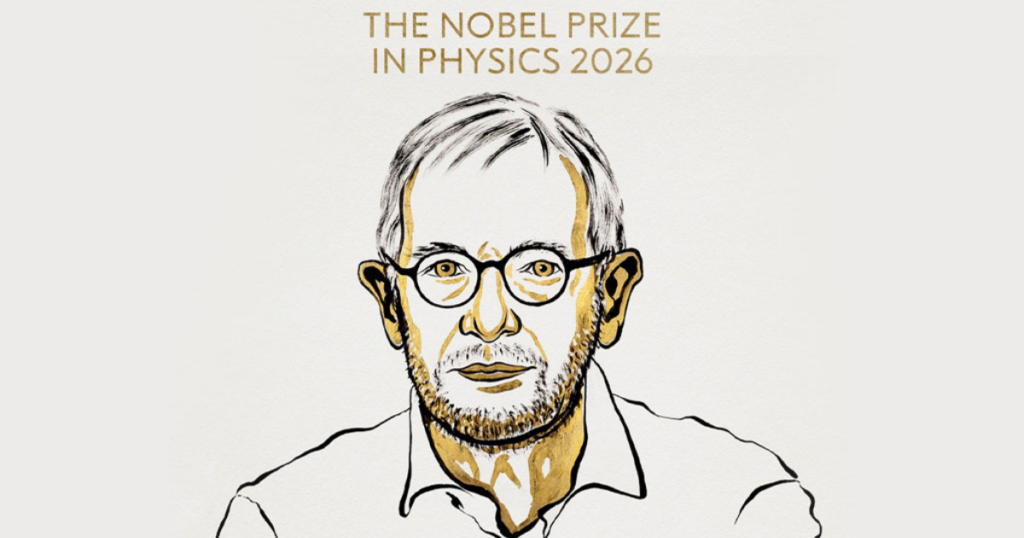
Francis Halzen has won the 2026 Nobel Prize in Physics for his contributions to the IceCube Neutrino Observatory and the discovery of high-energy neutrinos from space. His work has helped scientists explore some of the universe’s most energetic and mysterious events. Halzen is a physicist at the University of Wisconsin–Madison in the United States. His idea to use the ice beneath the South Pole to detect tiny particles has helped open a new way to study the cosmos.
What did Francis Halzen win the Nobel Prize for?

Francis Halzen was recognised for his decisive contributions to the IceCube Neutrino Observatory, a giant scientific facility built deep beneath the Antarctic ice. The observatory detects high-energy neutrinos, tiny particles that can travel across enormous distances through space and matter without being easily stopped.
Neutrinos can carry information from extreme cosmic environments, including regions around black holes and other powerful objects. Studying them helps scientists investigate events that may be difficult to understand using light alone.
What are neutrinos?
Neutrinos, tiny subatomic particles with no electric charge, interact very weakly with matter. This means they can pass through the Earth and our bodies without us noticing.
They are produced by various processes, including reactions inside the Sun and powerful events in space. Because neutrinos rarely interact with other matter, detecting them is difficult. Scientists need enormous detectors to catch the rare moments when these particles interact with atoms.
How does the IceCube Neutrino Observatory work?
IceCube uses about one cubic kilometre of clear Antarctic ice as a giant particle detector. Thousands of light sensors are placed deep beneath the surface to look for tiny flashes produced when neutrinos interact with matter.
When a neutrino collides with an atomic nucleus, it can produce other particles that give off a brief flash of light. IceCube’s sensors detect this light, allowing researchers to study the neutrino and investigate where it may have come from.
The observatory was completed in 2011. Its discoveries have helped establish neutrino astronomy, a way of studying the universe by detecting neutrinos rather than relying only on light.
Why is this discovery important?
High-energy neutrinos can travel from distant cosmic sources while carrying information about the extreme conditions in which they were produced. Unlike light, they can escape some dense environments without being absorbed or scattered in the same way.
By tracing these particles, scientists can investigate powerful cosmic events and learn more about distant galaxies and other energetic objects. This gives researchers another tool for exploring questions about how the universe works.
Francis Halzen first proposed the idea of using South Pole ice to detect neutrinos in 1988. His vision helped turn the concept into a major international scientific project involving researchers and engineers from around the world.
What is neutrino astronomy?
Neutrino astronomy, the study of the universe using neutrinos, allows scientists to investigate cosmic events through particles that reach Earth from distant sources. It complements traditional astronomy, which mainly studies light, and helps researchers explore parts of the universe that may otherwise remain difficult to observe.
FAQs on Francis Halzen
1. What is the difference between a neutrino and a photon?
A neutrino is a tiny particle that interacts very weakly with matter, while a photon is a particle of light. Both can carry information from distant objects in space, but they help scientists study the universe in different ways.
2. Can neutrinos pass through the human body?
Yes. Trillions of neutrinos pass through our bodies every second, mostly without interacting with any atoms. We do not feel them because they rarely interact with matter.
3. Who discovered neutrinos?
Physicist Wolfgang Pauli proposed the existence of neutrinos in 1930 to explain missing energy in a type of radioactive decay. Clyde Cowan and Frederick Reines later detected them experimentally in 1956.
4. Why is the IceCube Neutrino Observatory built at the South Pole?
The Antarctic ice is extremely clear and can act as a huge detector for the faint flashes produced by neutrino interactions. The remote location also helps researchers reduce interference from other sources of light.
5. What is the difference between neutrino astronomy and traditional astronomy?
Traditional astronomy mainly studies electromagnetic radiation, such as visible light, radio waves and X-rays. Neutrino astronomy studies particles that can travel from cosmic sources and reveal information about energetic events that light alone may not fully explain.
Also read about:
- Know The Nobel Prize 2025 Winners
- Who Won the 2026 Nobel Prize in Medicine? Meet the Three Scientists!
- Nobel Prize 2024 Winners: Names, Fields, Prize Amount & Achievements
- 10 Indian Scientists Who Made History with Amazing Discoveries
Subscribe to The Junior Age Newspaper – click here. Know more fun facts on The Junior Age’s YouTube!