
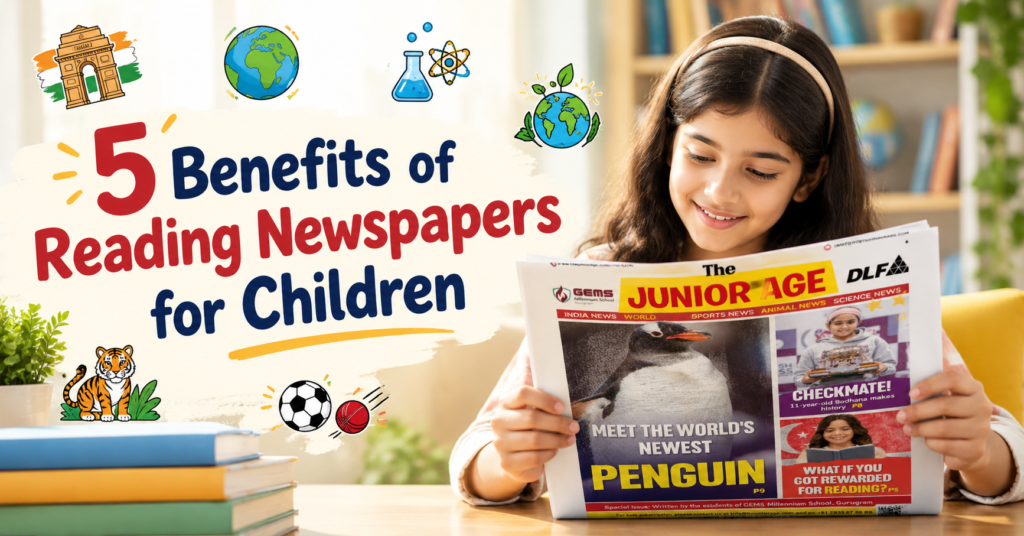
Children learn far more than what is written in their textbooks. They learn by asking questions, exploring new ideas and discovering what is happening around them. Reading the news can help make that learning more exciting. From space discoveries and wildlife stories to sports and new inventions, newspapers introduce children to the real world while encouraging them to become curious, confident readers. Here are five benefits of reading newspapers for children and why parents should consider making news reading part of their daily routine.
5 Benefits of Reading Newspapers for Children: Why News Matters for Young Minds
1. Connects school lessons to the real world
Textbooks teach children important concepts, but news stories show how those ideas work in everyday life.
- India: Understand how government decisions, festivals and important national events connect to what they learn in school.
- World: Discover different countries, cultures, landmarks and global events, bringing geography and history to life.
- Science: Explore space missions, new inventions and scientific discoveries beyond the textbook.
- Climate and environment: Learn how climate change, pollution and conservation affect our planet and everyday lives.
- Animals and wildlife: Discover fascinating species, their habitats and the importance of protecting wildlife.
- Sports: Connect physical education and mathematics to real matches, player statistics, scores and sporting achievements.
When children see classroom lessons in action, learning can become more relatable and interesting.
2. Builds critical thinking and vocabulary
News introduces children to new words, fresh ideas and different perspectives. It also encourages them to think beyond the information on the page.
How does reading newspapers for children help?
- Expands vocabulary: Children discover new words and understand their meanings through context.
- Encourages questions: They begin asking why something happened and what might happen next.
- Develops critical thinking: Discussing news helps children consider evidence, compare explanations and form their own views.
Parents can encourage this by asking simple questions such as, What surprised you about this story? or How do you think this problem could be solved?
3. Makes reading exciting and full of discovery
Not every child enjoys reading textbooks, but a fascinating story about a rare animal, a space mission or a sporting achievement might capture their attention.
News offers something for every interest.
- Real-life stories that spark curiosity
- A variety of topics, from science to sport
- Interesting facts children can share with others
- Opportunities to explore a subject beyond the article
One story about a dinosaur discovery, for example, might inspire a child to learn about fossils, prehistoric life and how scientists study the past.
When reading feels exciting, children have more reasons to pick up something to read again.
4. Encourages independent reading habits
When reading is linked only to homework and examinations, children may begin to see it as a chore. Age-appropriate news can help them discover the pleasure of reading for themselves.
How can parents help?
- Start with just 10 to 15 minutes of reading a day.
- Let children choose topics they enjoy.
- Encourage them to share one interesting fact from a story.
- Keep a newspaper or reading material easily accessible.
- Follow their questions and help them explore topics further.
The aim is not to make reading another task on a child’s timetable. It is to help them discover that learning can continue beyond the classroom.

5. Develops media literacy from an early age
Children come across information on websites, videos, social media and messaging apps. But not everything they see online is accurate.
Reading and discussing news can help children learn to question information instead of accepting every claim at face value.
Teach children to:
- Check the source: Who published the story?
- Look for evidence: Does the claim have reliable information to support it?
- Separate facts from opinions: Is the writer reporting an event or sharing a viewpoint?
- Compare information: Can another trustworthy source confirm the claim?
- Think before sharing: Is the information accurate, or could it be misleading?
These simple habits can help children become more thoughtful and responsible consumers of information.
How can parents make news reading a daily habit?
Building a reading habit does not need to be complicated. A few small steps can make a big difference.
- Read together: Share an interesting story and discuss it.
- Choose child-friendly news: Look for clear language and age-appropriate topics.
- Make it interactive: Ask children to explain what they learnt or create a quiz from a story.
- Connect news to everyday life: Discuss how a story relates to something they have learnt at school.
- Keep it enjoyable: Encourage curiosity rather than testing children on every article.
Even a short reading session can open the door to a fascinating conversation.
Did you know? A single news story can connect several school subjects. An article about a rocket launch, for example, can lead to questions about gravity, planets, engineering, mathematics and the people who make space missions possible.
That is the beauty of reading the news. One story can inspire a whole new journey of learning.
FAQs about the benefits of reading newspapers for children
At what age should children start reading newspapers?
Answer: Children can start with simple, illustrated news stories as soon as they are ready for reading material suited to their age. Parents can read aloud to younger children and introduce longer articles as their reading skills develop.
How much time should children spend reading the news?
Answer: Starting with 10 to 15 minutes a day can be a manageable way to build a routine. The focus should be on consistent, enjoyable reading rather than a fixed target.
Can newspaper reading help children in school?
Answer: It can support vocabulary, comprehension, general knowledge and understanding of real-world topics. These skills can complement classroom learning.
How can parents help children identify fake news?
Answer: Encourage children to check the source, look for supporting evidence and compare information with other reliable sources before believing or sharing a claim.
Is a printed newspaper useful when children can read news online?
Answer: Yes. A printed newspaper can offer a focused reading experience without notifications or endless scrolling. Online news can also be useful when it comes from reliable sources and is suitable for the child’s age.
Give your child the advantage of real knowledge
Children learn by exploring, questioning and discovering. Reading the news can help them connect school lessons to real life, build vocabulary, develop independent reading habits and become more thoughtful about the information they encounter. For parents, it can start with something as simple as sharing one interesting story a day.
Make reading a part of your child’s everyday routine
Give your child the advantage of real knowledge with The Junior Age Festive Bundle, featuring a children’s newspaper subscription and educational flashcards. From current affairs and fascinating discoveries to general knowledge and hands-on learning, The Junior Age helps make everyday learning more engaging.
- Festive Starter Bundle: 6-month subscription + 2 flash card packs, ₹1,800
- Festive Value Bundle: 6-month subscription + 3 flash card packs, ₹2,100
- Grand Festive Bundle: 1-year subscription + 4 flash card packs, ₹3,100
Also read:
- Flashcards vs. Screens: 5 Reasons Kids Learn Better Hands-On
- 10 Modern Ravanas in Every Child’s Daily Routine
- Why Reading Short Stories Every Day Helps Children Become Better Learners
- Sustainable Development Goal 4: Equal Learning Opportunities For All
Subscribe to The Junior Age Newspaper – click here. Know more fun facts on The Junior Age’s YouTube!