
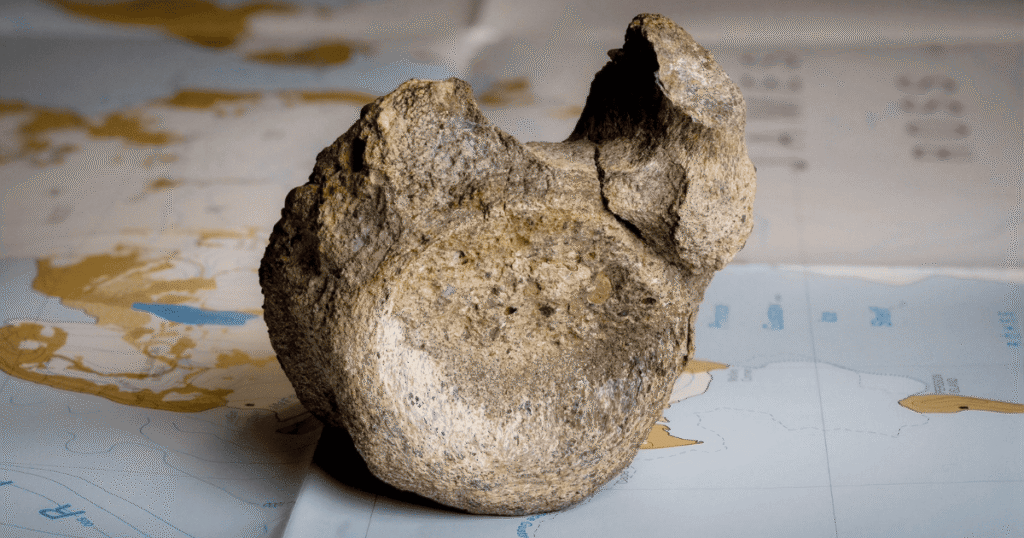
Imagine finding something so important that it changes history, even though it had been sitting unnoticed in a museum drawer for nearly 40 years! That is exactly what happened when scientists took another look at an old fossil collected from Antarctica. What was once thought to belong to a sea reptile turned out to be a remarkable discovery that has rewritten part of the continent’s prehistoric story. Researchers have now confirmed that the fossil is the first dinosaur bone ever discovered in Antarctica, proving that giant dinosaurs once roamed the frozen continent millions of years ago.
Antarctica’s first dinosaur bone discovered after 40 years
The fossil was originally discovered in 1985 by geologist Mike Thomson during a British Antarctic Survey expedition on James Ross Island, off the coast of Antarctica. At the time, Thomson believed the fossil belonged to a large marine reptile, so it was carefully labelled and stored in a museum collection. For decades, it remained untouched until palaeontologists from the University of Cambridge decided to examine it again.
Their careful study revealed something astonishing. The fossil was actually a tail vertebra, or backbone bone, from a titanosaur, a giant plant-eating dinosaur with a long neck and tail. The team’s findings were published in the scientific journal Acta Palaeontologica Polonica.
Meet the titanosaur
Titanosaurs were among the largest animals ever to walk on Earth. Some species grew longer than a school bus, although this particular dinosaur was much smaller. Scientists estimate the Antarctic dinosaur measured about 6 to 7 metres long and was probably a young individual rather than a fully grown adult.
The fossil is around 82 million years old, dating back to the Late Cretaceous Period, when dinosaurs still ruled the Earth. Today, Antarctica is covered by thick ice sheets and is the coldest continent on Earth. But 82 million years ago, it looked completely different. The continent had a much warmer climate, with forests, rivers, and lush vegetation. Dinosaurs, ancient birds, crocodile relatives, and many other prehistoric animals lived there.
This discovery provides more evidence that Antarctica was once part of a rich prehistoric ecosystem before it gradually became covered in ice.
Why is this discovery important?
Scientists say the fossil helps them better understand how dinosaurs spread across the ancient southern supercontinent known as Gondwana, which once connected Antarctica with South America, Africa, Australia, India, and Madagascar. As these landmasses slowly drifted apart over millions of years, dinosaurs were able to spread across different continents. The newly identified fossil adds another important piece to the puzzle of dinosaur evolution and migration.
Did you know? Titanosaurs were part of a group of dinosaurs called sauropods, famous for their incredibly long necks, long tails, and enormous size.
Read about: Some Interesting And Fun Dino Facts!
Subscribe to The Junior Age Newspaper – click here. Know more fun facts on The Junior Age’s YouTube!