
Across the world, millions of people still face unfair treatment because of where they live, how much money they earn, their gender, disability, religion, or background. While some communities have access to good schools, healthcare, clean transport, and safe housing, others struggle to meet even basic needs. This gap between people and communities is known as inequality. Inequality affects almost every part of life. It can limit opportunities, increase poverty, and make it harder for people to live healthy and secure lives. Children from disadvantaged communities are often affected the most because unequal access to education, nutrition, healthcare, and technology can shape their future opportunities from a very young age. To address this growing global challenge, United Nations created Sustainable Development Goal 10 as part of the 17 Sustainable Development Goals adopted in 2015. Sustainable Development Goal 10 focuses on reducing inequalities within countries and between countries. The goal encourages governments, organisations, schools, and communities to create fairer opportunities for everyone, regardless of their background.
Read about: Sustainable Development Goal 9: Innovation Builds A Better Future & Sustainable Development Goal 8: Decent Work And Economic Growth
What are the Sustainable Development Goals?
The Sustainable Development Goals are 17 global goals adopted by all United Nations member countries in 2015. These goals aim to make the world fairer, safer, healthier, and more sustainable by the year 2030. The 17 goals focus on important world issues such as:
- Poverty
- Hunger
- Education
- Clean water
- Climate change
- Gender equality
- Peace and justice
Each goal focuses on solving a different global problem. Together, they form a global plan to improve life for people and protect the planet. Sustainable Development Goal 10 focuses on reducing inequalities and creating equal opportunities so that all people can live with dignity, safety, and fairness.
Read: No Poverty SDG 1: Everything You Need to Know About the World’s First Global Goal
Sustainable Development Goal 10
Sustainable Development Goal 10 is called Reduced Inequalities. Its main purpose is to reduce unfair differences between people and communities across the world. This includes reducing income inequality, improving social inclusion, protecting human rights, and ensuring equal opportunities for everyone. The goal encourages countries to support vulnerable groups such as children, people with disabilities, migrants, refugees, older people, and low-income communities. It also promotes fair economic systems, equal access to services, and stronger laws against discrimination. Sustainable Development Goal 10 hopes to build societies where people are treated equally and have access to opportunities regardless of their race, religion, gender, disability, or financial condition. Key sectors involved include:
- Education
- Healthcare
- Employment
- Social protection
- Public policy
- Human rights organisations
- International cooperation
Read: Sustainable Development Goal 2: Ending Hunger For A Better Future
Why is Sustainable Development Goal 10 important?
Inequality affects billions of people around the world. In many countries, some communities still struggle to access quality education, healthcare, jobs, clean water, technology, and financial support. This creates large gaps between rich and poor populations. Children living in unequal societies may face challenges such as poor nutrition, limited schooling, unsafe housing, or fewer career opportunities. These problems can continue across generations if countries do not take action.
Inequality can also slow economic growth and increase social tensions. When people feel excluded or treated unfairly, it can lead to poverty, unemployment, conflict, and poor health outcomes. Climate change, wars, global economic crises, and pandemics have also increased inequalities in many parts of the world. Vulnerable communities are often affected the most during disasters or emergencies. Sustainable Development Goal 10 is important because it promotes fairness, inclusion, equal rights, and opportunities for everyone.
Know about: All About Sustainable Development Goal 3: Good Health And Well-Being
Main targets of SDG 10
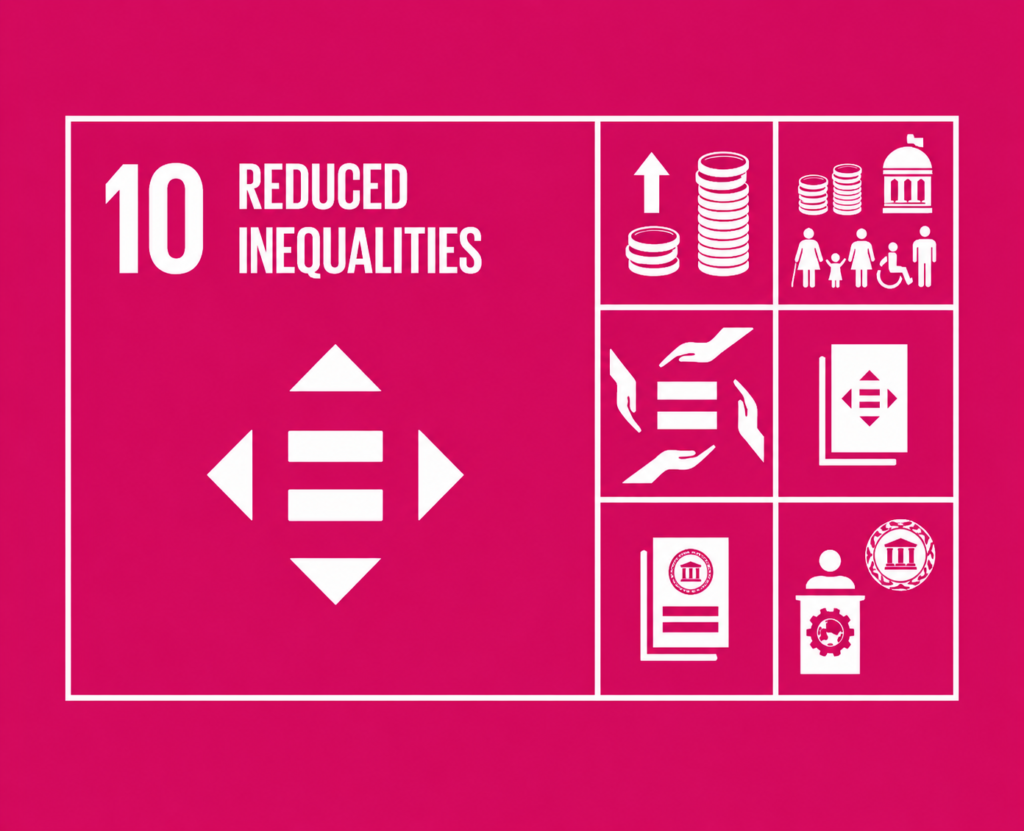
Sustainable Development Goal 10 has official targets created by the United Nations to reduce inequalities within countries and between countries. These targets focus on fairness, inclusion, equal opportunities, and better support for vulnerable communities worldwide.
Also, read: Sustainable Development Goal 4: Equal Learning Opportunities For All
1. Increase income growth for poorer populations
This target aims to improve the income growth of the poorest 40% of people in every country. It encourages fair economic opportunities and better living standards.
2. Promote social, economic, and political inclusion
This target focuses on ensuring that all people are included in society, regardless of age, gender, disability, race, religion, or economic background.
3. Ensure equal opportunities and reduce discrimination
Countries are encouraged to remove unfair laws and discriminatory practices so people receive equal treatment and opportunities.
4. Adopt fair financial and social policies
Governments are asked to create policies related to wages, taxes, and social protection systems that help reduce inequality.
5. Improve regulation of global financial markets
This target encourages stronger monitoring and regulation of global financial systems to create fairer and more stable economies.
6. Increase representation for developing countries
Developing nations should have a stronger voice in global economic and financial institutions and decision-making processes.
7. Support safe and responsible migration
Countries are encouraged to create safe, organised, and responsible migration policies that protect migrants and refugees.
8. Special treatment for developing countries
This target supports special trade and economic assistance measures for developing countries, especially least developed countries.
9. Reduce the cost of sending money home
The goal aims to lower the fees migrant workers pay when sending money to their families in other countries.
10. Improve data collection on inequality
Countries are encouraged to collect better and more reliable data related to inequality. Accurate data helps governments understand problems and create better solutions.
Also read: Sustainable Development Goal 5: Know All About Gender Equality
How are countries trying to reduce inequalities?
Countries and organisations around the world are taking different steps to reduce inequalities and create fairer societies.
Government actions
- Expanding free or affordable education
- Improving healthcare access
- Providing financial support for low-income families
- Creating anti-discrimination laws
- Supporting disability rights
International organisations
Groups such as United Nations Children’s Fund and World Bank support programmes that improve education, healthcare, nutrition, and social protection.
Schools and educators
Schools are promoting inclusive education so children from different backgrounds can learn together in safe environments.
Scientists and technology experts
Technology is helping more people access online education, digital banking, healthcare information, and communication tools.
NGOs and charities
Many non-governmental organisations support vulnerable communities by providing food, shelter, education, healthcare, and legal aid.
Know about: Why Clean Water is Important: Understanding Sustainable Development Goal 6
What can children do to help?
Children can also play an important role in creating a fairer and kinder world.
- Treat everyone with kindness and respect
- Include classmates who may feel left out
- Learn about different cultures and communities
- Speak up against bullying or discrimination
- Donate books, clothes, or toys to people in need
- Support community service activities
- Use social media responsibly to spread positive messages
- Learn about human rights and equality
Small actions can help build more inclusive communities and encourage fairness for everyone.
Frequently asked questions about Sustainable Development Goal 10
1. What does SDG stand for?
SDG stands for Sustainable Development Goals. These are 17 global goals created by the United Nations.
2. What is Sustainable Development Goal 10 about?
Sustainable Development Goal 10 focuses on reducing inequalities within and between countries.
3. Why is reducing inequality important?
Reducing inequality helps create fair opportunities, better living conditions, and safer societies for everyone.
4. Who is most affected by inequality?
Poor communities, migrants, refugees, people with disabilities, and vulnerable groups are often affected the most.
5. What causes inequality?
Inequality can be caused by poverty, discrimination, lack of education, unequal healthcare access, conflict, and economic differences.
6. How does inequality affect children?
Inequality can limit children’s access to education, healthcare, nutrition, safety, and future opportunities.
7. Can technology help reduce inequality?
Yes. Technology can improve access to education, healthcare, communication, and financial services.
8. What is social inclusion?
Social inclusion means ensuring all people can fully participate in society without discrimination or unfair treatment.
Read about: Sustainable Development Goal 7: Affordable And Clean Energy
Subscribe to The Junior Age Newspaper – click here. Know more fun facts on The Junior Age’s YouTube!