
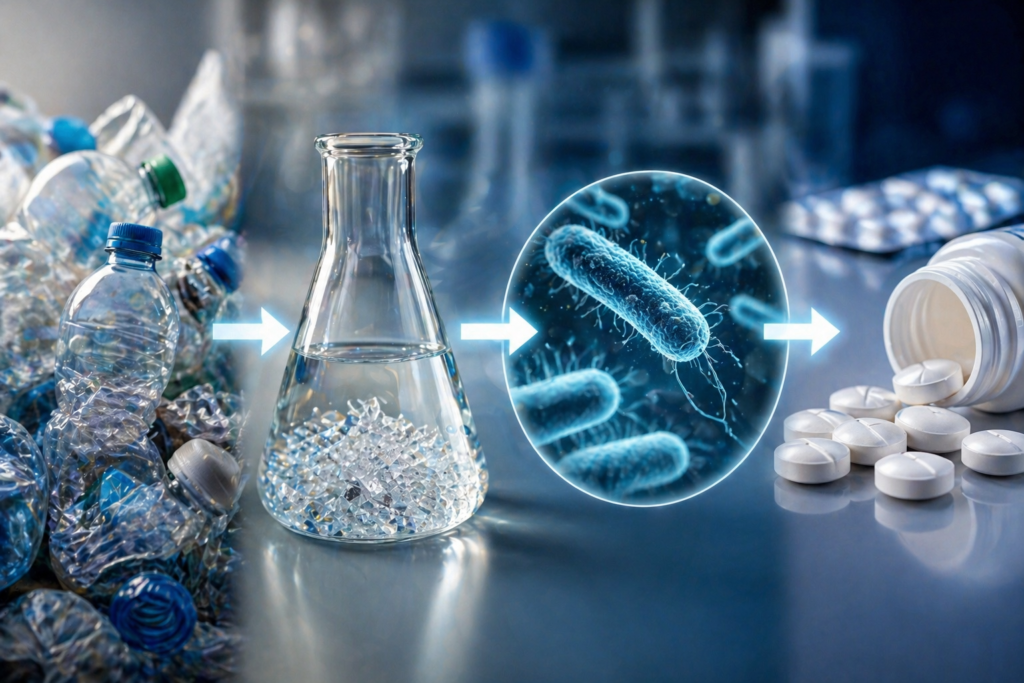
Plastic pollution is one of the biggest environmental challenges facing the planet today. Every year, millions of tonnes of plastic end up in landfills, rivers, and oceans. Scientists around the world are searching for smart ways to reuse this waste instead of letting it pollute the environment. A new scientific breakthrough now shows that plastic could even help create important medicines. Researchers at the University of Edinburgh in Scotland have developed a method to convert plastic waste into a medicine used to treat Parkinson’s disease.
The team used specially engineered Escherichia coli bacteria to turn chemicals from plastic into a drug called Levodopa, which helps people with Parkinson’s control their movements. The discovery shows how waste materials could be turned into life-saving products instead of harming the planet. For now, the process is still being tested in laboratories, and scientists say more research is needed before it can be used on a large industrial scale.
Scientists turn plastic waste into Parkinson’s medicine
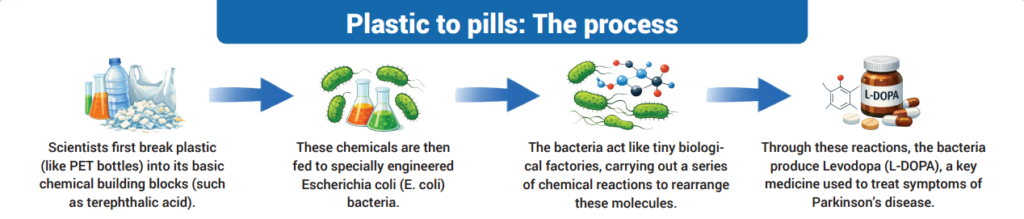
Plastic to pills: the process
Step 1: Plastic breakdown
Plastic such as PET bottles is broken into basic chemical building blocks, including a compound called terephthalic acid.
Step 2: Laboratory processing
These chemicals are placed in laboratory conditions where scientists prepare them for biological reactions.
Step 3: Bacteria at work
Specially engineered E. coli bacteria act like tiny biological factories. They rearrange the plastic-derived chemicals through a series of reactions.
Step 4: Medicine produced
The reactions produce Levodopa (L-DOPA), a medicine widely used to treat symptoms of Parkinson’s disease.
What is Parkinson’s disease?
Parkinson’s disease is a brain disorder that affects how people move. It happens when the brain does not produce enough of a chemical called dopamine, which helps control smooth body movements. People with Parkinson’s may experience:
- Shaking hands or tremors
- Slow movement
- Difficulty balancing
The condition mostly affects older adults. There is no cure yet, but medicines such as Levodopa can help reduce symptoms and improve movement.
Problem-Solving Case Study: Plastic Waste Challenge
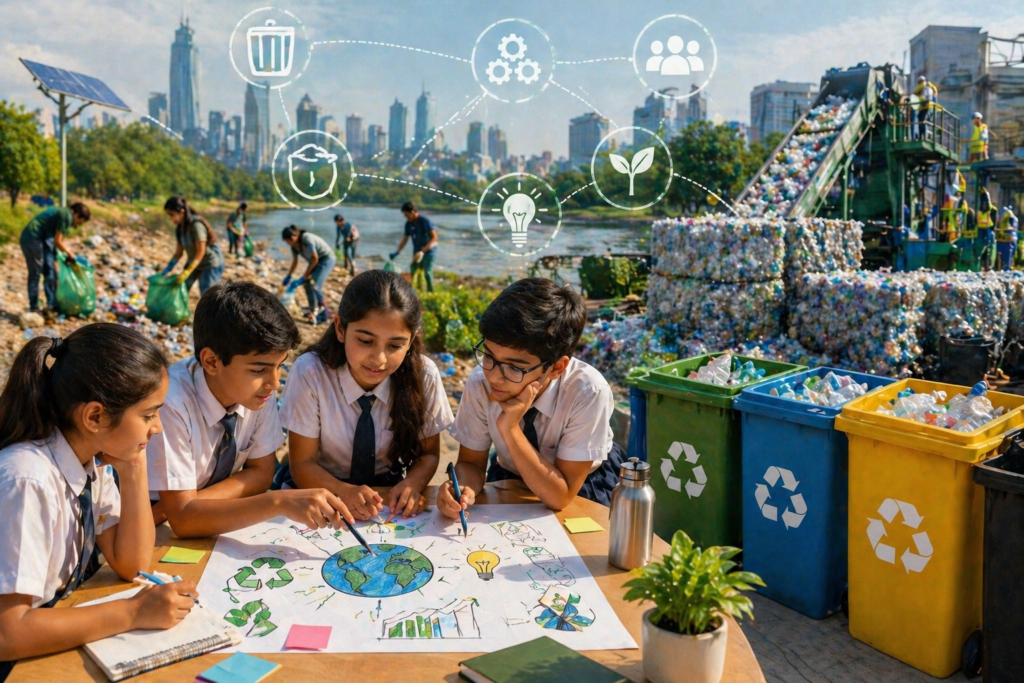
Plastic waste in your city is increasing rapidly. Roads, parks, and water bodies are becoming polluted. The government and citizens are worried and searching for solutions. You are part of a Young Innovation Team. Your mission is to design a practical plan to tackle plastic waste.
Understand the problem
- Where is most plastic waste coming from? Homes, shops, food packaging, delivery items.
- What problems is it causing? Pollution, harm to animals, blocked drains, and health risks.
Identify key areas to fix
- Collection: How plastic waste is gathered
- Recycling: How it can be reused or processed
- Awareness: How people learn to reduce plastic use
Create your solution plan
Write 5-7 clear steps such as:
- Reduce single-use plastics in schools and public events.
- Install separate bins for plastic waste in neighbourhoods.
- Organise monthly recycling drives.
- Encourage shops to switch to reusable or biodegradable packaging.
- Set up a local recycling centre for plastic collection.
- Reward households that reduce plastic waste.
- Partner with scientists or companies that turn plastic into useful products.
Add innovation
Think creatively.
- Can bacteria or machines convert plastic into new materials?
- Can an app help people locate recycling centres?
- Can plastic be turned into construction materials or useful products?
Think about impact
- How will your plan reduce pollution?
- How will animals, rivers, and cities benefit?
- How will people’s health and surroundings improve?
Please share your case study with us on info@thejuniorage.com.
Subscribe to The Junior Age Newspaper – click here. Know more fun facts on The Junior Age’s YouTube!